
The Export Papers · Part II of IV
How to export cocopeat from India: every code, registration, test and document
Published guides to this trade disagree on the tariff code, the certificates and even the tonnage a container holds. This one settles each point from the primary papers, written from inside the Pollachi trade, and marks plainly the few that must still be checked before a container is booked.
Rules last verified · 13 September 2026
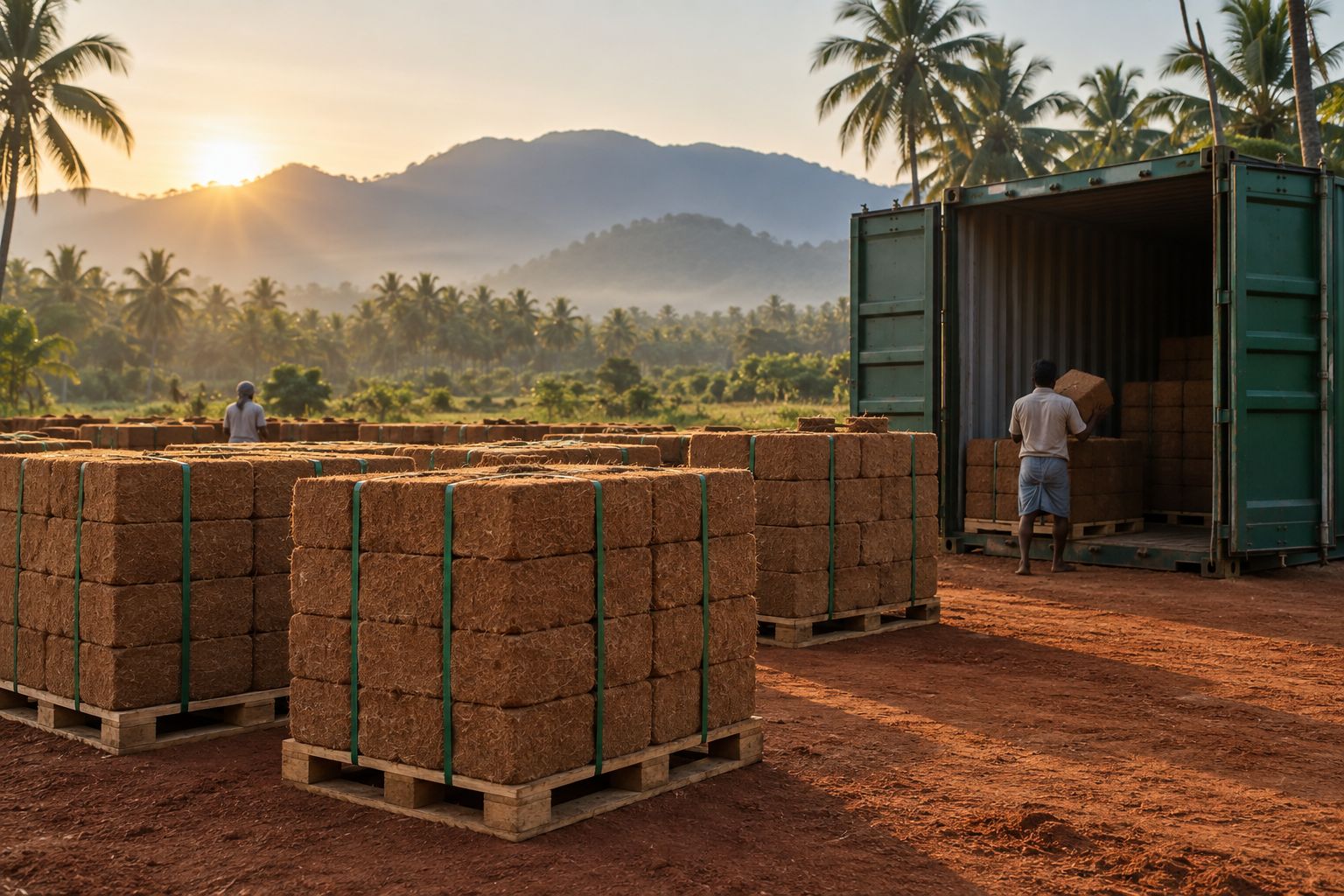
How to export cocopeat from India comes down to four jobs: register as an exporter, classify the goods, meet the destination's plant-health rules, and ship a lot that matches its test report. In practice that means an IEC, GST registration with a Letter of Undertaking, Coir Board registration with an RCMC, tariff line 5305 00 40, and a PPQS phytosanitary certificate wherever the importing country asks for one. Cocopeat (coir pith) is the spongy material left when the long fibre is pulled from coconut husks; the trade uses both names for the one material, and so does this guide. Each step below carries its fee, its form and its authority, and the few points still to be confirmed are marked as such.
In short
- The code: cocopeat is 5305 00 40 in India's tariff. Importers declare it as 5305 00 00 00 in the UK, 5305.00.00 in the USA and CN 5305 00 00 in the EU.
- The registrations: an IEC (₹500), GST with an LUT, and Coir Board registration with an RCMC (₹11,800 and ₹9,450 in the Board's 2017 guidelines; confirm today's fees).
- Plant health: a PPQS phytosanitary certificate where the destination requires one (Japan does; Korea and China treat cocopeat as a quarantine item), and fumigation only where the buyer or importing country asks.
- Quality: washed, low-EC grades read below 0.5 mS/cm, and every figure needs its test method beside it.
- Money: realise the proceeds within 9 months of export; RoDTEP returns 2.4% of FOB, capped at ₹1 a kilo, but is notified only to 30 September 2026.
Can you export cocopeat from India?
Yes. Any business with an IEC and GST registration can export cocopeat from India, and the Coir Board's guidelines expect coir exporters to register with the Board as well. It is the trade's largest line: coir pith made up 61.16% of India's coir exports by volume in 2024-25, 8,21,264 tonnes worth about ₹2,590 crore, according to the Board.
The wider export of coir and coir products from India reached 13,42,843 tonnes worth about ₹4,343 crore that year, up 27.9% in value, and pith alone rose 41% in value. By value, the largest buyers were the USA (24.46%), China (22.10%, and first by volume at 37.81%), the Netherlands (7.54%), Spain (4.84%), the UK (4.77%) and Korea (4.39%).
One figure needs correcting before it reaches a business plan. The India Brand Equity Foundation (IBEF) gives India's 2024-25 coir exports as US$ 434 million; that appears to be the Coir Board's rupee total, ₹4,34,345 lakh (about ₹4,343 crore), with a dollar label. Use the Board's rupee figures and leave IBEF's dollar totals aside.
The HS code for cocopeat and coir products
The HS code for cocopeat in India is 5305 00 40, the tariff line for coir pith in blocks, briquettes, coins, discs, grow bags, organic manure and loose form for horticulture or agriculture. That is DGFT's own description in Appendix 4R, so it settles the coir pith HS code for every usual export form, grow bags included. Some published guides give 5305 00 90 ("others") instead; on DGFT's wording, pith belongs in 5305 00 40.
The first six digits, 5305 00, are shared worldwide; the digits after them are each country's own. The Indian shipping bill therefore says 5305 00 40, while the importer declares the goods under its own national line.
| Product | Code | Tariff | Note |
|---|---|---|---|
| Cocopeat (coir pith): blocks, briquettes, coins, discs, grow bags, loose | 5305 00 40 | India | DGFT Appendix 4R wording: coir pith in value-added and loose form for horticulture or agriculture |
| Coir fibre: bristle, mattress, short, bit and decorticated | 5305 00 10 | India | Fibre, not pith |
| Curled or machine-twisted coir fibre | 5305 00 30 | India | Fibre, not pith |
| Coco husk chips | No dedicated line | India | Confirm with your customs broker, or seek an advance ruling, before the first shipment |
| Coir, pith included (importer's code) | 5305 00 00 00 | UK | 0% duty, also 0% under the India-UK agreement; 20% import VAT |
| Coir, pith included (importer's code) | 5305.00.00 | USA | General duty Free; a 10% Section 301 tariff has applied to most Indian goods since 24 July 2026, so confirm with a US broker |
| Coir, pith included (importer's code) | CN 5305 00 00 | EU | 0% duty from India; pure, unused coir admitted, blends with other organic matter banned |
Coco husk chips are the gap. No tariff line names them, so confirm the classification with your customs broker, or seek an advance ruling from customs, before the first shipment. The RoDTEP rate and the GST rate both follow the code you declare.
Step 1: IEC, GST and the LUT
Every Indian exporter starts with the same three papers: an Importer Exporter Code (IEC) from DGFT, GST registration, and a Letter of Undertaking (LUT) that lets you ship without paying IGST. Searches for a cocopeat export licence usually mean the IEC. Part I, on export norms in India, takes each paper in depth.
No separate DGFT licence should be needed. Coir pith carries a RoDTEP rate in DGFT's Appendix 4R, a benefit not given to restricted or prohibited goods, so it appears to be a free export. Confirm its entry in ITC(HS) Schedule 2, which sorts every export into Free, Restricted, Prohibited or State Trading.
- Get the IEC. Apply on dgft.gov.in. DGFT's own guidance lists PAN, address proof, a bank account in the holder's name, Aadhaar matching the PAN, and a DSC or Aadhaar e-sign. The fee is ₹500 and the code lasts for life, but it must be updated online every year between April and June, or DGFT deactivates it.
- Register for GST. Coir pith is taxed at 5% on domestic sales (Notification 9/2025-Central Tax (Rate), S. No. 338), consistent with the Tamil Nadu Authority for Advance Ruling's 2018 decision in Jeena Exports. Exports themselves are zero-rated.
- File the LUT, or choose the refund route. An LUT on Form GST RFD-11, valid for one financial year, lets you export without IGST and claim back unused input tax credit. Alternatively, pay IGST on the shipment; the shipping bill then serves as the refund claim.
- Register on ICEGATE. Customs' portal needs a Class 3 DSC. Register your bank's AD code and account there before the first shipping bill, because IGST refunds and RoDTEP credits are paid into that account.
Step 2: Coir Board registration and RCMC
The Coir Board's guidelines require every exporter of coir and coir goods to register with the Board, which also issues the trade's RCMC (Registration-cum-Membership Certificate). Its 2017 guidelines list ₹11,800 for export registration and ₹9,450 for the RCMC, or ₹21,250 for both.
Two cautions before you pay. The guidelines name coir fibre, yarn, rope and products, but not coir pith by name, although the Board counts pith as a coir product in its export statistics. The Board's website was also unreachable on 13 September 2026, so confirm the requirement and the current fees with its Regional Office in Pollachi.
| Item | Export registration | RCMC |
|---|---|---|
| Fee in 2017 | ₹11,800 (₹10,000 plus 18% GST) | ₹9,450 (₹10 fee plus ₹9,440 service charge with GST) |
| Both together | ₹21,250 | |
| Validity | No expiry stated | 5 years, ending 31 March of the fifth licensing year |
| Returns | Monthly export return by the 30th of the following month, NIL returns included | |
| Changes | Report changes in ownership, constitution, name or address within 6 months | |
| Where to file | Online, then hard copies to a regional office (Pollachi has one) or to Kochi | |
The 2017 guidelines ask for the application form, an overseas export order, a bank certificate of financial standing, PAN, IEC, a code of conduct, the firm's constitution deeds and receipts for the PMSBY and PMJJBY insurance schemes; manufacturer-exporters add Udyog Aadhaar and IE registration. The Board's rules page cites the Coir Industry (Registration) Rules 2008: Form V to apply, Form VI for the certificate.
DGFT has also run a common e-RCMC platform for councils and boards since December 2021, so ask the Board which route it uses now. One thing the Board no longer does is hold your container for inspection. Compulsory pre-shipment inspection of coir under the Export (Quality Control and Inspection) Act 1963 began in 1965, was relaxed in 1991 and was later withdrawn; the 2017 guidelines describe Coir Board inspection as a voluntary service, on request and for a fee.
Step 3: Does cocopeat need a phytosanitary certificate?
Only when the destination asks for one. Japan requires a phytosanitary certificate for coco peat, Korea and China treat cocopeat as a quarantine item, and the EU's plant-health annexes list none for coir shipped on its own, although buyers may still ask for one.
- Japan: the Plant Protection Station lists coco peat among goods that need an exporting-country phytosanitary certificate and an import inspection (list updated 1 April 2023).
- South Korea: coco peat is handled as a plant-quarantine item, so expect a certificate and an inspection on arrival (from a European plant health authority's summary of Korean rules; confirm with the importer).
- China: a draft rule notified to the WTO in May 2024 permits coir, but requires producers registered through the exporting country's plant protection authority, bags labelled in Chinese and English, and an ISPM 12 certificate before export.
- European Union: Implementing Regulation (EU) 2019/2072 admits unused growing media made entirely of coconut fibre, bans blends with other organic matter, and lists no certificate for coir shipped alone.
- United Kingdom: the UK Trade Tariff showed no phytosanitary measure on 5305 00 00 00 on 13 September 2026; wooden pallets must meet ISPM 15.
- USA, Australia and others: confirm current conditions with the importer before booking. Part III, cocopeat import rules by country, sets out what each market asks.
Where a certificate is needed, the Directorate of Plant Protection, Quarantine and Storage (PPQS) issues it through its online portal, PQMS. This is how to get a phytosanitary certificate in India, in order:
- Apply on PQMS. Register on pqms.cgg.gov.in and file an export application for the consignment and its destination.
- Inspection and sampling. PPQS inspects the consignment and its packing, and samples are tested against the importing country's requirements.
- Treatment, if required. Where the destination or buyer demands treatment, an agency accredited by PPQS carries it out.
- Certificate. PPQS issues the phytosanitary certificate in the ISPM 12 model format, the international standard layout.
Fees and timelines are set by PPQS and paid through PQMS; the PPQS pages read for this guide do not state them, so check the portal when you apply. Book the inspection early, because the certificate must describe the lot that actually sails.


Step 4: Fumigation, ISPM 15 pallets and certificates of origin
Cocopeat needs fumigation only when the importing country or the buyer requires it; there is no blanket rule, and where treatment is done, an agency accredited by PPQS carries it out and certifies it. Two other papers sit beside it: the ISPM 15 mark on wooden pallets and the certificate of origin.
| Paper | Who issues it | When you need it |
|---|---|---|
| Fumigation or treatment certificate | An agency accredited by PPQS | Only when the importing country or the buyer requires treatment |
| ISPM 15 mark on wooden pallets | A treatment provider accredited by PPQS | Whenever wooden pallets travel; the UK requires it |
| Non-preferential certificate of origin | Filed online on DGFT's eCoO 2.0 platform, trade.gov.in | When the buyer or destination customs ask for proof of origin |
| Preferential certificate of origin | DGFT's eCoO platform | Only to claim a trade-agreement duty rate |
| Coir Board inspection certificate | Coir Board, on request, for a fee | Voluntary; compulsory inspection was withdrawn |
DGFT moved non-preferential certificates of origin online through eCoO 2.0; published reports date the mandatory switch to 1 January 2025 and give the fee as ₹200. For a UK buyer, a preferential certificate saves nothing on coir. The UK charges 0% on 5305 00 00 00 to every country, and the India-UK agreement, in force since 15 July 2026, keeps it at 0%.
Cocopeat export quality: EC, pH, moisture and expansion
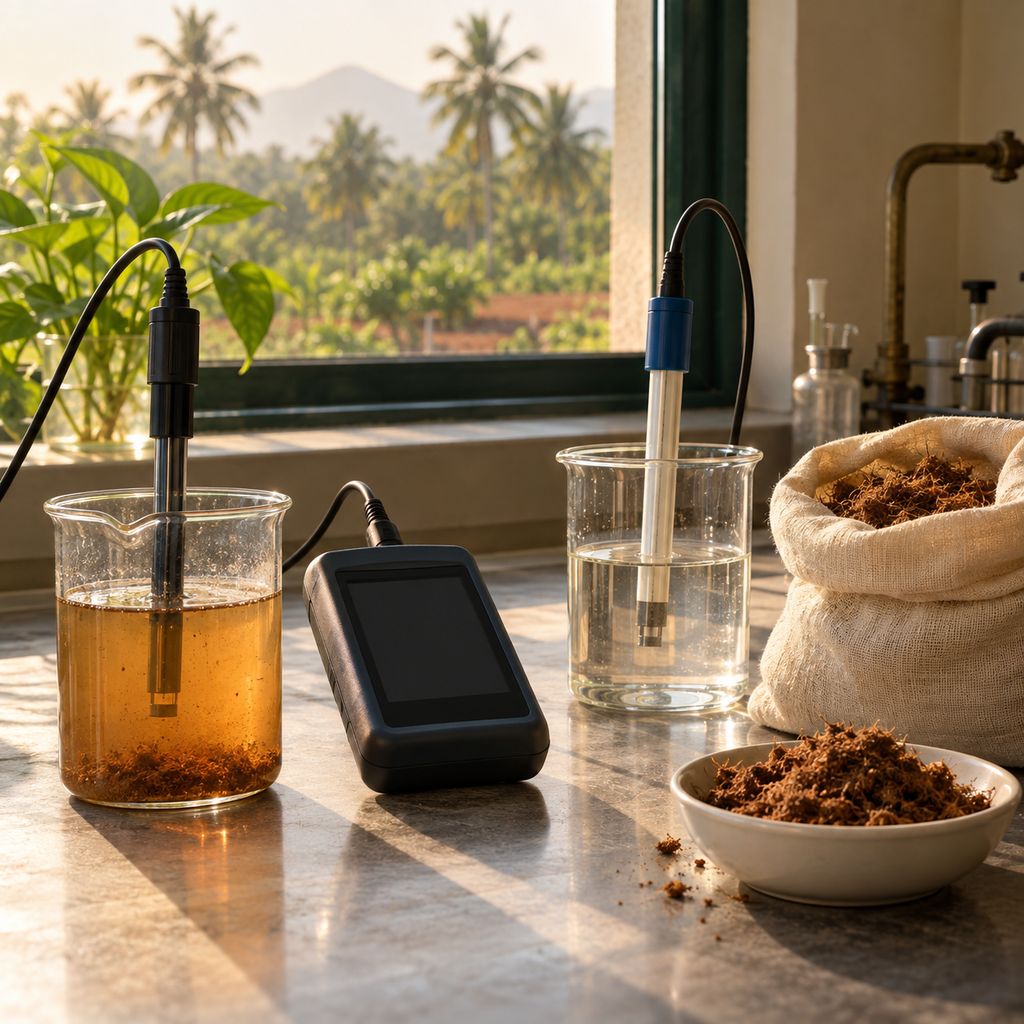
Export cocopeat is judged on five numbers, EC, pH, sodium, moisture and expansion, and each means something only beside its test method. By producers' grading, washed or low-EC cocopeat reads below 0.5 mS/cm and high-EC above 0.8; the EU Ecolabel ceiling for growing media is 1.0 mS/cm.
The method matters as much as the figure. A 1:1.5 volume extract and a saturated media extract read differently from the same material, so an EC figure without its method cannot be compared with the buyer's own test. The EU Ecolabel criteria for growing media (Decision (EU) 2015/2099) name EN 13038 for EC and EN 13037 for pH; the scheme is voluntary, but it gives both sides a shared reference.
| Parameter | What buyers ask | Test method |
|---|---|---|
| EC (salinity) | Washed or low-EC: below 0.5 mS/cm. High-EC: above 0.8. EU Ecolabel ceiling: 1.0 mS/cm | 1:1.5 volume extract, or EN 13038; state which |
| pH | 4 to 7 under the EU Ecolabel; one producer's published buyer checklist asks 5.5 to 6.8 | EN 13037 |
| Sodium | EU Ecolabel: at most 150 mg per litre of fresh product | Agree the laboratory and method in the contract |
| Moisture at dispatch | Producers quote about 10 to 20%; fix the figure in the contract | Agree the method with the buyer's laboratory |
| Expansion per 5 kg block | The house's blocks take 20 to 25 litres of water and give roughly 70 to 75 litres of substrate | Hydrate a whole block and measure the volume |
| Contaminants and plant response | EU Ecolabel criteria for physical contaminants, weed seeds, E. coli and Salmonella | CEN/TS 16202; EN 16086-1 for plant response |
The house's washed low-EC coir reads at or under 0.50 mS/cm by the 1:1.5 method, and each lot's certificate prints the method beside the number. Whether a crop needs washed or buffered pith is a separate question, answered plainly in buffered or unbuffered; the house sells both grades, as 5 kg cocopeat blocks and buffered cocopeat. For an independent test inside India, the Coir Board's own institute, CCRI at Kalavoor in Alappuzha, runs a coir pith testing laboratory.
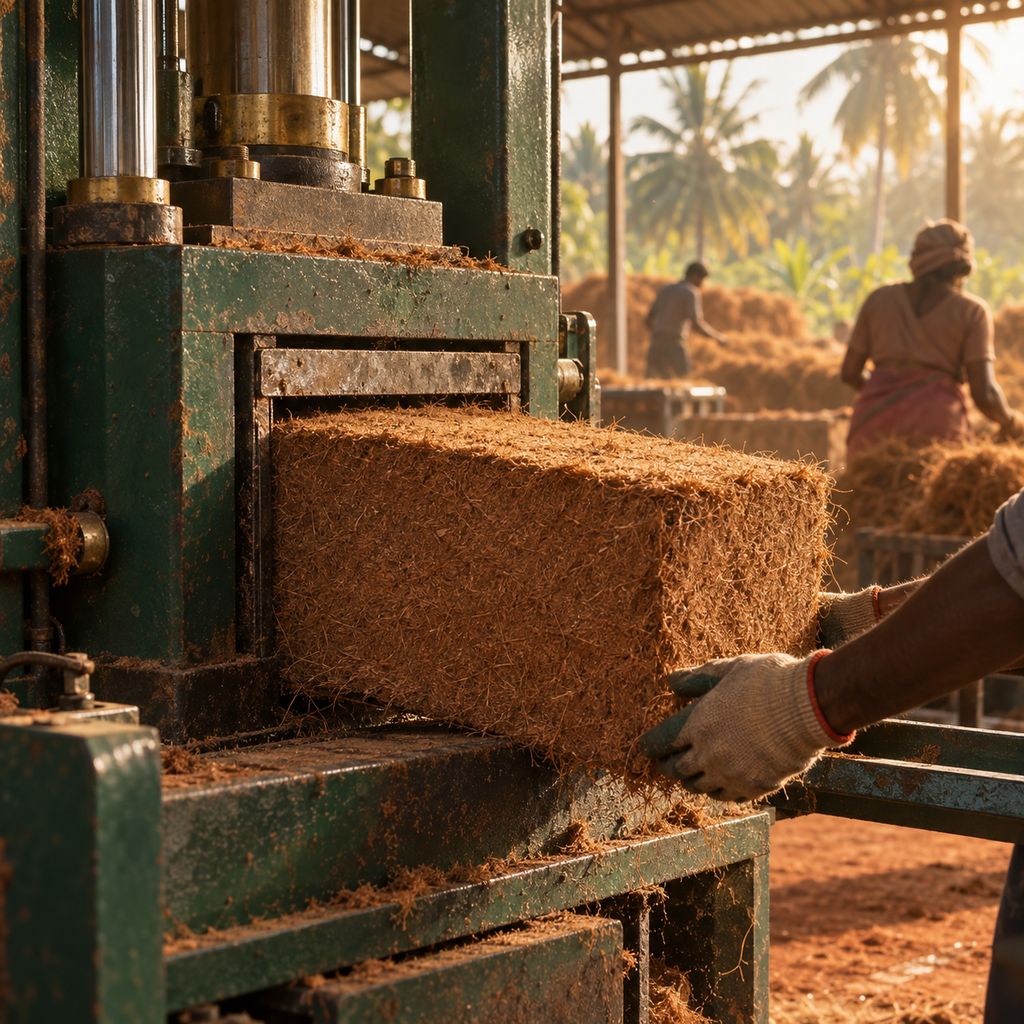
Moisture is agreed, never assumed. Producers quote between about 10 and 20% at dispatch, and every extra point is water the buyer pays freight on without gaining substrate, so write the figure and its method into the contract. The house's own account of drying is a morning in the drying yards.
Packing and container loading
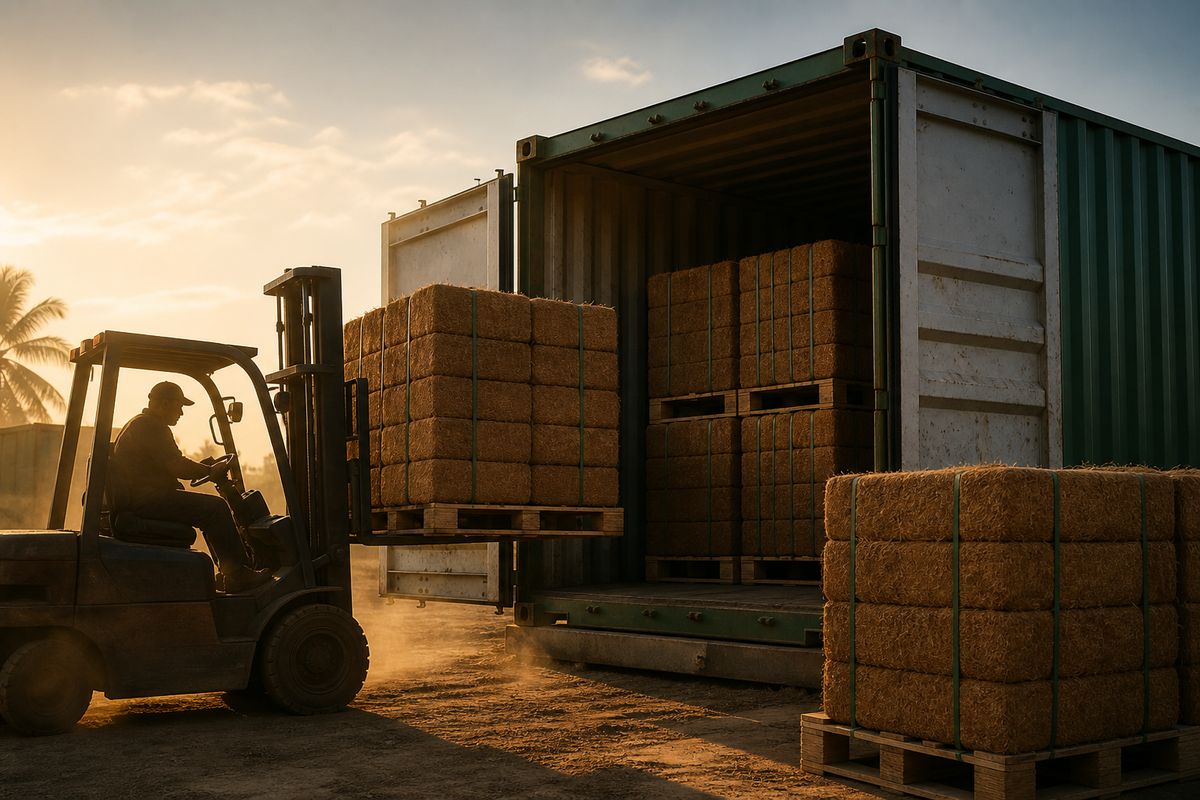
A 40 ft high cube container takes about 20 pallets of 220 to 240 five-kilo blocks, 22 to 24 tonnes, or up to about 26 tonnes floor-loaded, by producers' published figures. Cocopeat also ships as briquettes, grow bags and husk chips, but the 5 kg block is the format with published loading figures, so the table uses it.
| Format | Per pallet | Per 40 ft high cube | Source |
|---|---|---|---|
| 5 kg blocks, palletised | 220 to 240 blocks | About 20 pallets: 22 to 24 tonnes | Producers' published loading figures |
| 5 kg blocks, floor-loaded | Not palletised | 4,400 to 5,300 blocks: up to about 26 tonnes | Producers' published loading figures |
| 5 kg blocks, UK-spec pallets | 180 blocks, about 900 kg, one lot serial | 21 pallets: about 18.9 tonnes | Pollachi Coir house specification |
| Briquettes, grow bags, husk chips | Varies by format | Varies; ask for a written loading plan | No consistent published figure |
The house's UK-spec pallets carry less, on purpose. Each takes 180 blocks, about 900 kg, stacked to a height UK hauliers accept for kerbside delivery, so twenty-one pallets fill a container at about 18.9 tonnes. Palletising trades tonnage for handling. Each pallet carries one lot serial and one certificate, and every loading is filmed.
From Pollachi to the port
India's coir leaves through three main ports: in the Coir Board's 2021-22 export review, the latest port split found, Tuticorin earned over 46% of coir export value, Cochin 34% and Chennai 20%. From Pollachi, Tuticorin and Cochin are the nearer two. Searches for coir pith exporters in Tuticorin often reflect where the containers sail: much of the pith is pressed inland, in yards such as those of the Pollachi coir cluster, and reaches the port already palletised or floor-loaded.
Where the container is stuffed decides the customs route. Under factory stuffing, the exporter loads at the yard under self-sealing and closes the box with an RFID e-seal; otherwise the cargo moves to a CFS or ICD and is stuffed there under customs supervision. Either way the shipping bill is filed on ICEGATE, customs assesses it and may select the cargo for examination, and the Let Export Order releases it for loading. After sailing, the carrier files the Export General Manifest, which releases the IGST refund and RoDTEP.
Documents for one cocopeat shipment
One cocopeat shipment needs, at minimum, a commercial invoice, packing list, shipping bill, bill of lading and certificate of origin, plus a phytosanitary certificate and a treatment certificate where the destination requires them. The full list for one container:
- Commercial invoice showing 5305 00 40, the Incoterm (FOB, CFR or CIF, under Incoterms 2020) and the lot numbers
- Packing list: pallets, blocks per pallet, net and gross weights
- Shipping bill filed on ICEGATE, and the Let Export Order that clears it
- Bill of lading from the carrier, which then files the Export General Manifest
- Certificate of origin: non-preferential through eCoO 2.0, or preferential where an agreement rate applies
- Phytosanitary certificate from PPQS, where the destination requires one
- Fumigation or treatment certificate, where the destination or buyer requires treatment
- ISPM 15 marks on every wooden pallet
- Laboratory report for the lot: EC with its method, pH, sodium and moisture
- Marine insurance certificate, for CIF sales
- An LUT on file for the financial year, or IGST paid on the shipment
- For China: producer registration and bags labelled in Chinese and English, under the 2024 draft rule
- For a UK entry: the importer declares code Y923, goods not waste, against 5305 00 00 00
- After sailing: the Coir Board's monthly export return, due by the 30th of the following month
Cocopeat leaves India on paper before it leaves on water.
Buyers check the same papers from the other side of the table; Part IV sets out how buyers vet cocopeat exporters in India.
What it costs and how long it takes
The fixed costs are small: ₹500 for the IEC and, in the Coir Board's 2017 guidelines, ₹21,250 for export registration and the RCMC together. Everything else varies by shipment or is set by the authority involved. No timeline below could be confirmed from a published source, so the table says "varies" rather than guess.
| Item | Cost | Time |
|---|---|---|
| IEC from DGFT | ₹500, once; the yearly update carries no charge | Varies; update every April to June |
| GST registration and LUT (Form GST RFD-11) | Set by the authority | Varies; the LUT runs for one financial year |
| Coir Board export registration | ₹11,800 (2017 guidelines; confirm) | Varies; no expiry stated |
| RCMC from the Coir Board | ₹9,450 (2017 guidelines; confirm) | Varies; valid 5 years to 31 March |
| ICEGATE registration and AD code | Set by the authority | Varies; complete before the first shipping bill |
| Laboratory test for the lot | Varies by laboratory | Varies |
| Phytosanitary certificate | Set by PPQS, paid through PQMS | Set by PPQS; follows inspection and sampling |
| Fumigation or other treatment | Varies by accredited agency | Varies |
| Certificate of origin (non-preferential) | Reported as ₹200 | Varies |
| Customs clearance, CFS or port charges, freight | Varies by port, line and season | Varies |
| RoDTEP credit, paid to you | 2.4% of FOB, capped at ₹1 a kilo | After the Export General Manifest; notified to 30 September 2026 |
| Payment from the buyer | Not a cost | Realise within 9 months of export |
The payment deadline is recent. RBI's notifications show the period lengthened to 15 months in November 2025 and cut back to 9 on 5 June 2026 (goods sent to overseas warehouses still get 15), so older articles quoting 15 months are out of date for most shipments. Plan a cocopeat export business on the 9-month rule.
What moves the cocopeat export price
Five things move the cocopeat export price per ton: the grade (washed, buffered or high-EC), the format, the moisture at dispatch, how much the container carries, and the market it is bound for. The Coir Board's 2024-25 figures show how wide the spread runs. Dividing coir pith's export value by its tonnage gives an average of about ₹31,500 a tonne. Across all coir products, the same division gives about ₹18,900 a tonne for China, which buys lower-value bulk, and about ₹63,560 for the USA.
Freight is paid per container, so every tonne a container does not carry raises the freight share of the rest, and every point of moisture is water paid for twice, at the scale and on the ship. RoDTEP returns 2.4% of FOB on coir pith, capped at ₹1 a kilo, so the cap bites once FOB passes about ₹41.7 a kilo (Appendix 4R, in force since 10 October 2024).
For UK buyers the house publishes its band: £749 to £899 a pallet ex VAT, delivered kerbside, and £13,500 to £17,000 ex VAT for a container of twenty-one pallets. At about 900 kg a pallet, that is roughly £830 to £1,000 a tonne delivered in the UK, not an FOB price. The current pallet and container prices are published, and a sample kit lets you test the grade before a pallet is booked.
How to export cocopeat: your questions answered
What is the HS code for cocopeat?
In India, cocopeat (coir pith) is classified under 5305 00 40, the line DGFT describes as coir pith in briquettes, coins, discs, grow bags, organic manure and loose form for horticulture or agriculture. Coir fibre is 5305 00 10 and curled coir 5305 00 30. Importers use their own codes: 5305 00 00 00 in the UK, 5305.00.00 in the USA and CN 5305 00 00 in the EU.
Is Coir Board registration mandatory?
The Coir Board's guidelines require every exporter of coir and coir goods to register with it, and the Board also issues the coir trade's RCMC. The guidelines do not name coir pith, although the Board counts pith as a coir product in its statistics. Its website was down on 13 September 2026, so confirm with the Board's Pollachi Regional Office before your first shipment.
What are the Coir Board RCMC fees?
The Coir Board's 2017 guidelines list ₹9,450 for the RCMC (a ₹10 fee plus a ₹9,440 service charge including GST) and ₹11,800 for export registration (₹10,000 plus 18% GST), or ₹21,250 for both. The RCMC runs for five years, to 31 March of the fifth licensing year. Fees may have changed since 2017, so confirm them with the Board before paying.
How to get a phytosanitary certificate in India online?
Apply on PQMS, the online portal of the Directorate of Plant Protection, Quarantine and Storage (PPQS). PPQS inspects the consignment and its packing, tests samples against the importing country's requirements, has any required treatment done by an accredited agency, and issues the certificate in the ISPM 12 model format. Fees and timelines are set by PPQS and paid through PQMS.
Does cocopeat need fumigation?
Not by default. Fumigation or any other treatment follows the importing country's rules or the buyer's contract; where it is required, an agency accredited by PPQS carries it out and certifies it. Wooden pallets are a separate matter: they must meet ISPM 15 for the UK, so check every destination's pallet rule as well as its rule for the cargo.
How many tonnes of cocopeat fit in a 40 ft container?
Producers' published figures give about 20 pallets of 220 to 240 five-kilo blocks, 22 to 24 tonnes, in a 40 ft high cube, or up to about 26 tonnes floor-loaded. UK-spec pallets carry less: the house loads 21 pallets of 180 blocks, about 18.9 tonnes, because each pallet is stacked to a height UK hauliers accept.
What EC should export cocopeat have?
Washed, low-EC cocopeat reads below 0.5 mS/cm and high-EC grades above 0.8, by producers' grading, while the EU Ecolabel ceiling for growing media is 1.0 mS/cm by EN 13038. Always ask which method produced the number, because a 1:1.5 volume extract and a saturated media extract read differently. The house's washed coir reads at or under 0.50 mS/cm by the 1:1.5 method.
Every figure above can be checked, and the house would rather be checked than believed. Each pallet it ships carries one lot serial and one certificate, every loading is filmed, and the lab certificate published with every lot is there to read before anything is booked. If you are weighing a cocopeat exporter in India, begin with those papers, then put the questions in Part IV to whoever you choose.