Issue No. 1 · The Claim
Why Pollachi is the coir capital of the world
The claim on the house's letterhead is not decoration; it is a documented title, and this first issue enters the evidence.
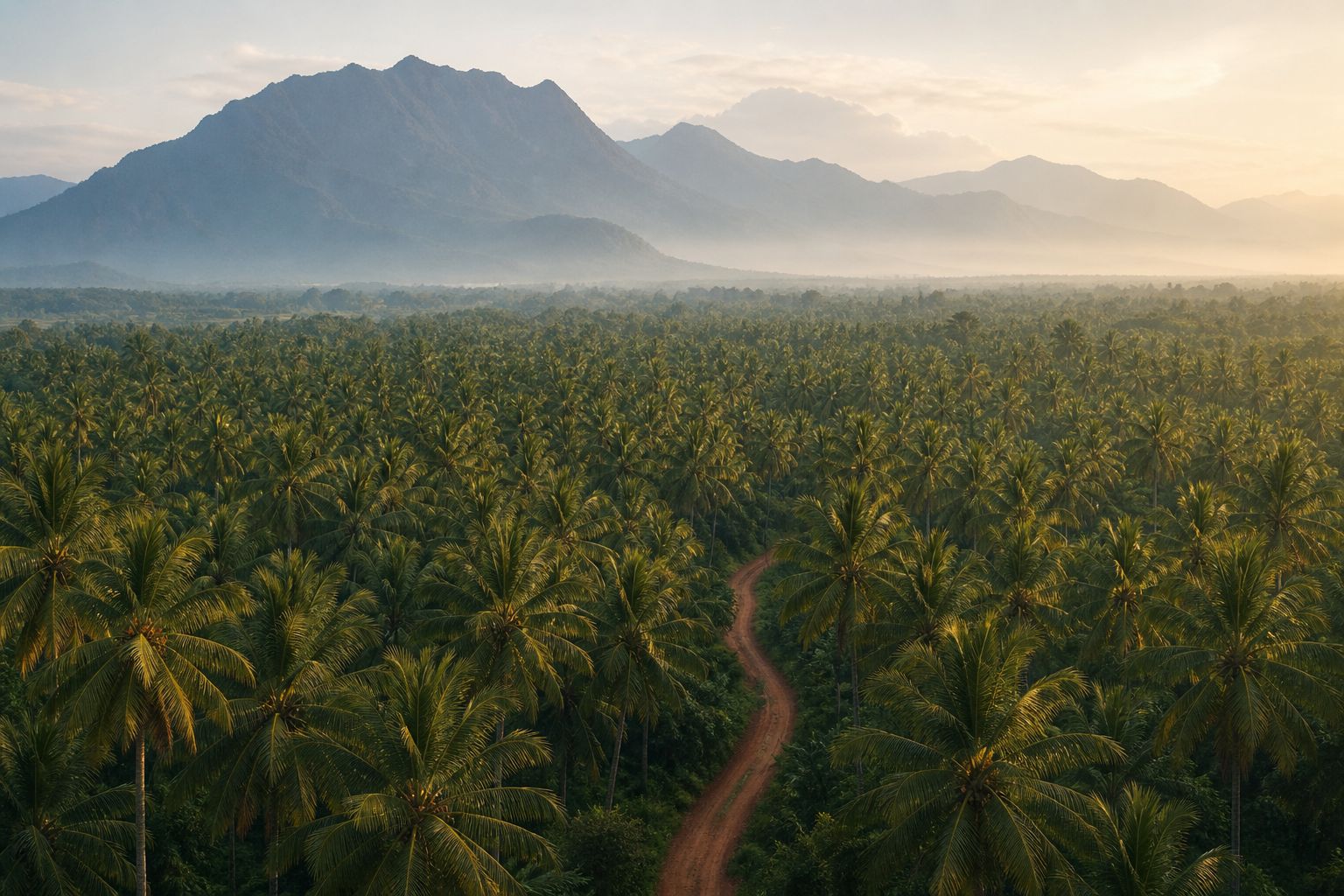
Every trade keeps one town whose name settles its arguments. Wine has its famous slopes; wool had its dales; ask where coir lives, and the trade answers with a market town on the dry side of the Western Ghats, where the plains of Coimbatore district run up against the wall of the Anaimalai. The house opens its Ledger with the largest claim it will ever set in type: that Pollachi, பொள்ளாச்சி, is the coir capital of the world. A claim of that size deserves better than a flourish on a letterhead. It is made here the way the town itself would make it: in the open, with the goods on the table and the figures spoken aloud, so that any reader may handle the evidence and weigh it. What follows is the case.
Exhibit I
The Geography
Begin with the land, because the land began it. Pollachi sits in the rain shadow of the Anaimalai range, the high southern shoulder of the Western Ghats: the mountains take the monsoon's first violence on their far side and hand the town a drier, kinder sky. That dryness is not a hardship; it is an instrument. Air that carries little moisture will draw it patiently out of anything laid open to the light, and a trade whose whole middle passage is the slow curing of fibre could not have commissioned a better climate. Water arrives by another door: the Aliyar works gather the mountains' rainfall and bring it down to the plain in ordered channels, so that the groves drink from the hills while standing in sunshine. And beneath the palms lies the red laterite earth, open and free-draining, the colour of a fired pot, in which the coconut roots deeply and stays a lifetime.
The names on the map give their own testimony. Pollachi is held to come from Porul Achi: the land of wealth; the town has carried that meaning long enough to have earned it. The old Tamil name for the coconut palm argues the same case from the other side. It is கற்பக விருட்சம், the wish-granting tree of the classical imagination: the tree that answers whatever is asked of it, whether food, oil, timber, thatch or rope. Dry air for curing, mountain water for washing, red earth for the roots: the geography did not merely permit a coir industry here; it designed one, and the language had named the parties long before the first block was pressed.
Exhibit II
The Scale
A capital requires a hinterland, and Pollachi's is counted in a unit the English ledger must stop to translate. The region holds roughly 1.2 lakh hectares of coconut palms. A lakh is one hundred thousand; the entry therefore reads some hundred and twenty thousand hectares of standing grove, the densest blocks of coconut acreage in Coimbatore district. Figures of that order stop behaving like numbers and become a landscape. Stand anywhere on the plain and look towards the mountains: the crowns run unbroken to the misted blue of the Anaimalai, canopy overlapping canopy until the horizon itself is made of fronds. The house calls it the canopy sea, and the phrase is description, not poetry.
The scale is patient as well as wide. A palm gives for sixty years: the tree a grower sets out this season will still be bearing when his grandchildren keep the books, and a grove is therefore not a crop so much as a settlement. An industry founded on such a plant does not lurch with fashion; it accumulates. Husk falls, is gathered, and falls again, season upon season, decade upon decade, and a trade standing on that rhythm can plan in generations where others plan in quarters. The grove is the slowest form of capital there is, and among the surest.
Exhibit III
The Cluster
Acreage alone makes a plantation; a capital requires the work to gather. Around five hundred coir units operate in the Pollachi cluster: soaking pits, fibre mills, drying yards, screening lines and block presses, standing near enough to one another to share weather, labour and judgement. Skill travels between yards with the people who hold it, and a method proved on one ground is common property by the next season. The Government of India's Coir Board has recognised the concentration in the formal manner of governments, with a cluster programme that carries the town's name. The house takes the recognition as confirmation rather than news: the paperwork is catching up with what the map has shown for a generation.
Density of this kind is its own machinery. Because the units stand shoulder to shoulder, a husk is milled within sight of the grove that dropped it, and its pith is on a drying yard before the day turns; nothing waits, and nothing travels far enough to lose its history. The consequence may be stated plainly, and it bears scrutiny: most of the world's coir pith passes within a morning's drive of the town. Leave Pollachi at first light on any road you please, and by breakfast you will have passed more coir in its making than most ports see in a season.
Exhibit IV
The Market
Every capital keeps an exchange, and Pollachi's has met on Tuesdays for some two hundred years. The சந்தை gathers cattle, coconut, copra and the jaggery that carried the town's name across Asia long before a block of pith ever boarded a ship. It was old before the trade the house serves existed, and it will convene next Tuesday whether or not anyone writes about it. Nothing about it is ceremonial. It is a working floor: heaped goods on open ground, animals changing hands, tea and இளநீர் going round while the day's rates find their level in the ordinary way, which is to say aloud.
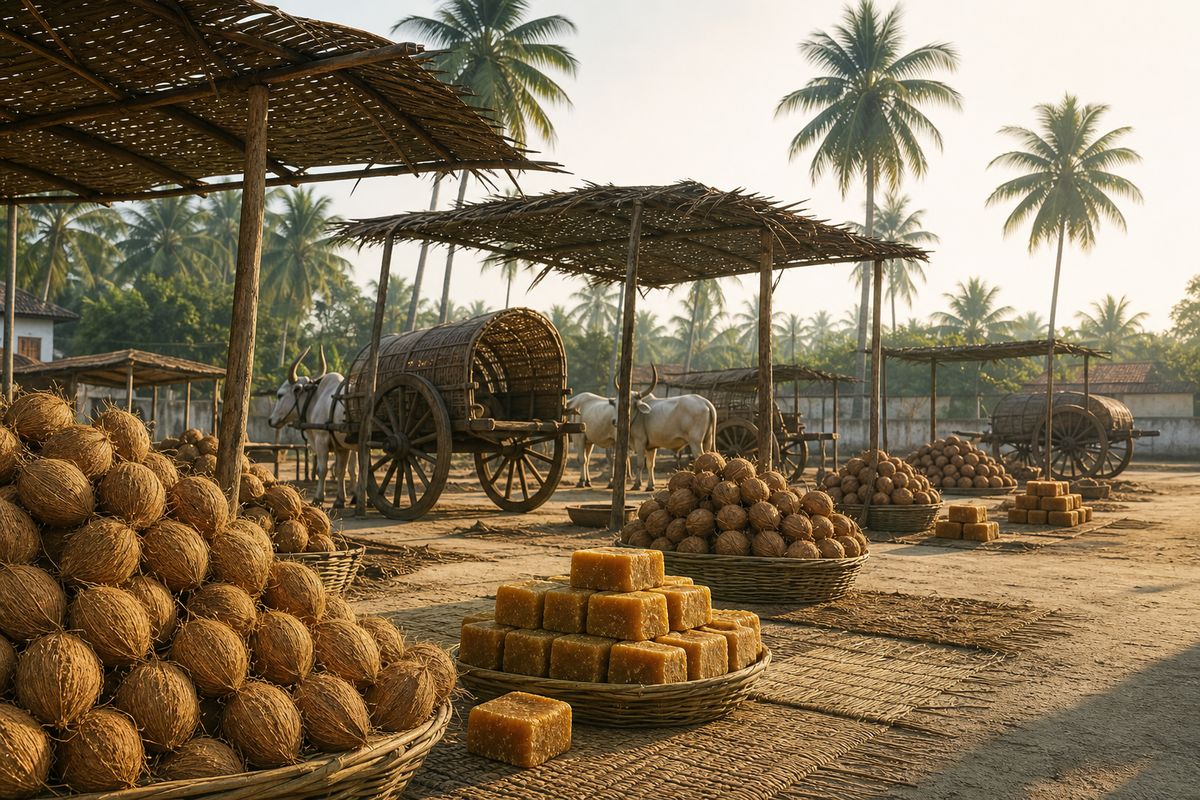
The manners of that floor are the substance of this exhibit. At the sandhai, goods are judged in the open: the buyer's hand goes into the heap, the husk is split there and then, the copra is turned over in the light in front of whoever cares to watch. Prices are spoken aloud, within hearing of neighbours and rivals alike, and a trader who quotes one figure to one face and a different figure to the next will find that the floor keeps a long memory and a short patience. Two hundred years of Tuesdays have schooled the town in a particular commercial honesty: not the honesty of sermons, but the kind enforced by standing close enough to be overheard. The sandhai does not issue certificates; it issues reputations, and a reputation is the harder document to forge.
The title is not a boast; it is a debt the town services every Tuesday.
That discipline, more than any acreage, is what a capital of trade actually rests on. The groves supply the goods; the sandhai supplies the manners.
Exhibit V
The Word
If geography, scale, cluster and custom have not settled the matter, language will. The English word coir is not English at all. It is the Tamil கயிறு, kayiru: rope. The word walked out of this coast with the cargo it named, boarded with it, and never came home. Every port manifest that lists coir, every dock ledger and bill of lading in every harbour that receives the fibre, speaks a word of Tamil without knowing it; there are few trades anywhere whose very noun is on loan from the language of one district.
There is an older fitness underneath. The record-keeping of this country was itself once written on the palm: the ஓலைச்சுவடி, the palm-leaf manuscript, carried the accounts, the deeds and the poetry of the Tamil land for centuries. The tree supplied the page, then the cargo, then the word the cargo travels under; a Ledger such as this one is only the latest entry in a very long account. A claim that can call the dictionary as its closing witness may safely do so, and rest.
The Judgment
What the Title Obliges
A finding, then; and with it a sentence, because a title of this kind is not a possession but a standard to be kept. The house reads the obligation in three clauses. Publish honestly: the house's pallet prices stand printed on a public page, from £699 to £849 ex VAT, the same figures before every reader, because a price whispered is a price negotiable, and the sandhai does not whisper. Pay promptly: the yards and mills the house buys from are settled the way the Tuesday floor settles, in full and without theatre. Put the town's name on the finest of what it makes: nothing ordinary should travel under the word Pollachi.
None of this required invention. The house's register of pallets, its numbered certificates, its published analyses: these are the sandhai's manners written down, the open heap and the spoken price translated into papers that can cross an ocean. A verified pallet is Tuesday morning, exported.
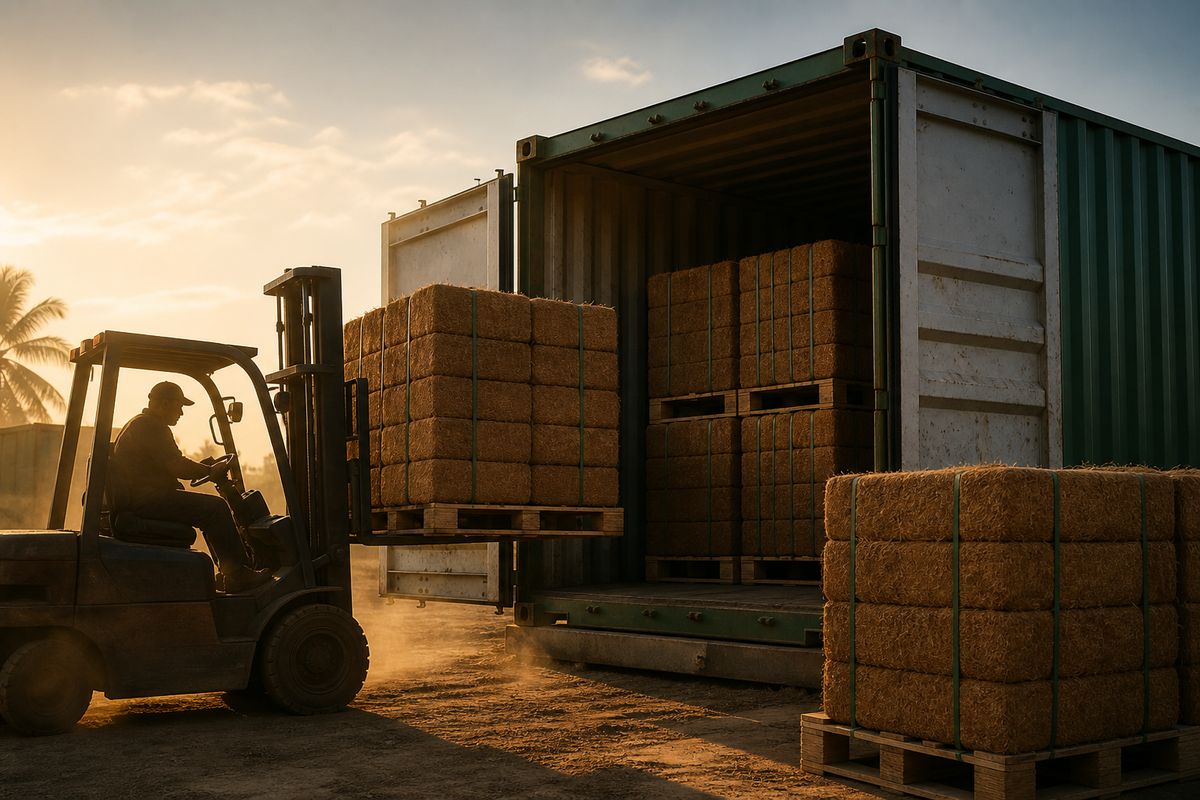
So the claim stands as entered. The geography that designed the industry; the hundred and twenty thousand hectares that feed it; the five hundred units that work it; the two centuries of Tuesdays that schooled it; the word the world borrowed to name it. The house did not confer the title and cannot revoke it; it can only work to deserve its place on the letterhead. Somewhere on the plain this morning a husk is going into the soak, and six weeks of sun from now it will leave for a country whose growers and retailers are turning away from peat and asking, with growing urgency, what will take its place. Supply of the old material tightens by the year, and the demand for an honest alternative grows with it. That question is new; the answer has kept the same address for two hundred years. The case rests.