The Record · Table
The tender nut, first gift of the tree
Before the husk was an industry, the young nut was a kindness. On இளநீர், the water of the roadside, and on the three small doors in the shell that gave the house its marks.
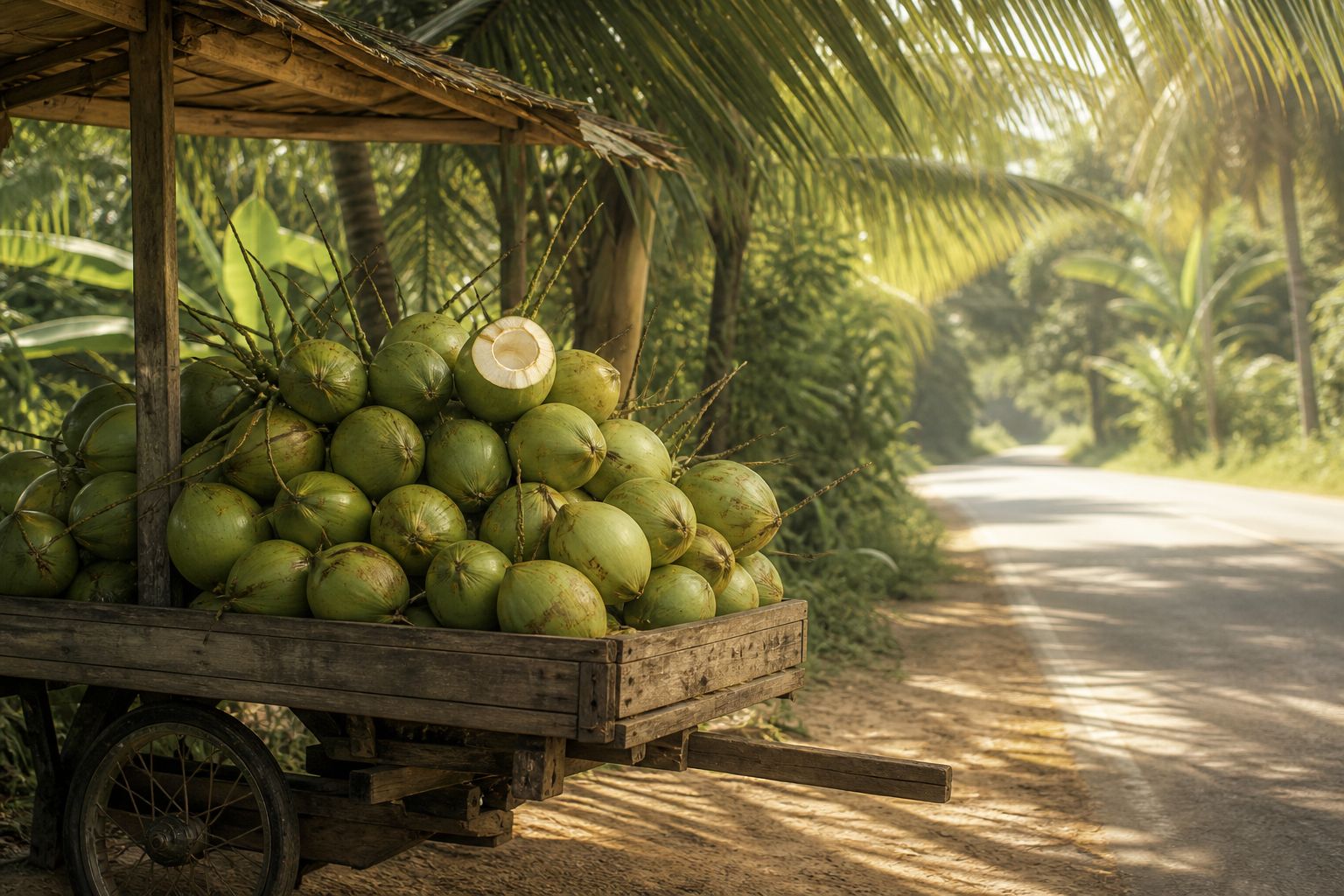
The cart waits where the shade falls, at the edge of a road out of பொள்ளாச்சி, stacked with green nuts still cool from the grove. A lorry slows, then a scooter, then a car full of children; nobody planned to stop, and everybody stops. This is இளநீர், ilaneer, tender coconut water: the belt's oldest refreshment, cut open while you stand there and handed over still dripping. Long before the husk became an industry, before the yards and the presses and the pallets, the young nut was simply this: a kindness at the side of the road, sold for small coins, finished in minutes, remembered all day.
I
The Roadside
Every road out of the town has its carts and stalls, and so does every road across the belt. The stock is a green pyramid; the tools are a long knife, a hook for the spent shells, and a practised eye. The seller chooses by hand and by ear: the weight of the water, the sound the nut gives back, the colour at the stem. Then the strokes, and there are never many: a few to flatten the base so the nut will stand, a few to pare the crown, one to open it. Nothing is repeated and nothing is flourished, because the price of a careless cut is the drink itself, spilt on the red earth. It is an economy of strokes, learned the way handwork is learned across the belt: by standing beside someone who already knows.
The Tuesday சந்தை has run in this town for two centuries, and the roadside cart is its daily echo: a market of one seller, no ledger, and a currency of thirst. The belt sits in the rain shadow of the Anaimalai range; the heat is dry, the roads run long between towns, and so the thirst is honest and the cart has never needed to advertise. The house admires the cart for a professional reason. It is the shortest supply chain the coconut has ever had: palm, knife, hand. The nut is grown, opened and finished within sight of the tree that gave it.
II
The Anatomy
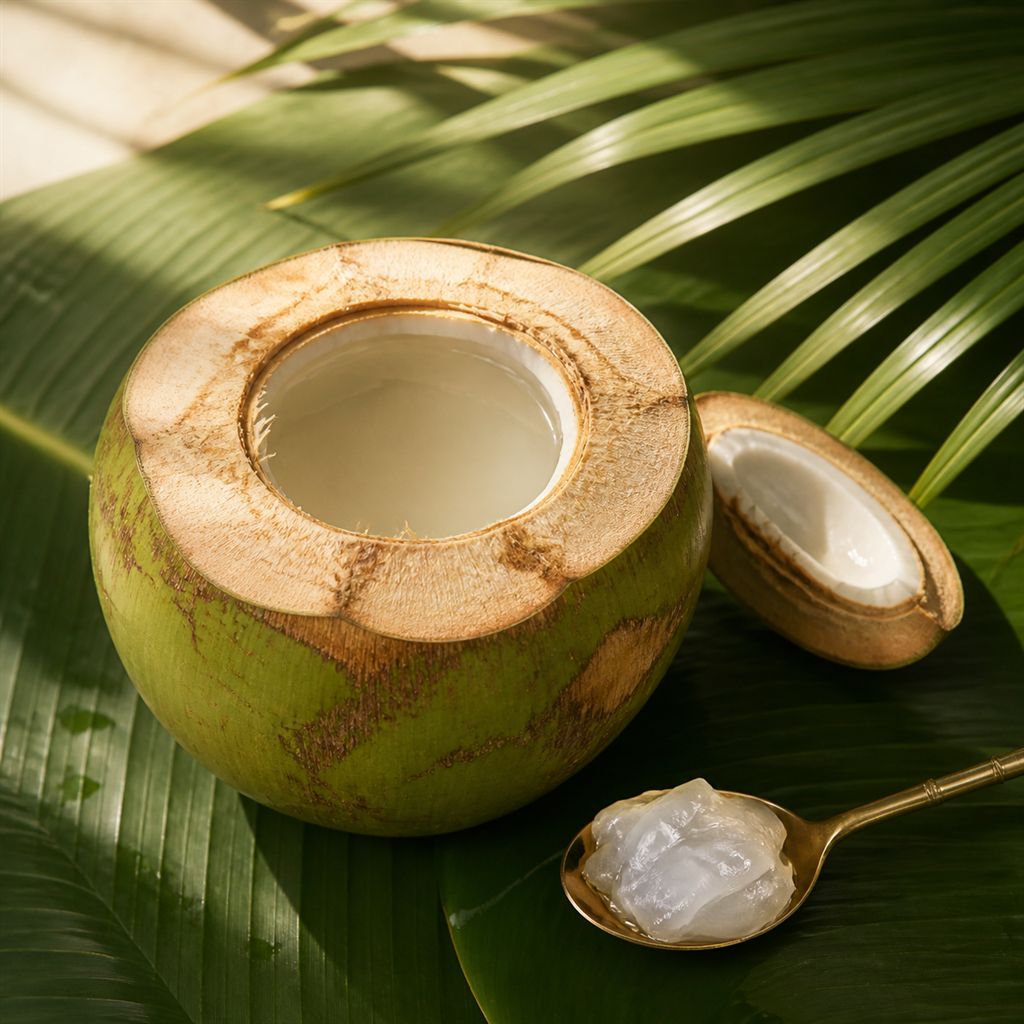
A tender nut is a matter of timing. It is cut young, before the kernel sets, while the nut is mostly water and the shell has not yet hardened into armour. Opened, it holds more than a glass: clear, faintly sweet, cooler than the day whenever the cart has kept its stock in the shade. Held whole in the hand it is a flask, filled and sealed by the tree.
Around the water lies the kernel, or the beginning of one: a soft, translucent layer that barely holds its shape, eaten with a spoon once the water is done. The spoon is the cart's quiet masterpiece. The seller splits the emptied nut, cuts a sliver from the shell, and hands the nut back with cutlery carved from itself; the whole gesture takes less time than describing it. Left on the palm, the moment passes: the kernel firms and whitens, the water gives ground to flesh, and the nut moves on to its other lives. The tender nut is not a variety; it is a window, and the cart trades entirely inside it.
III
The Three Pores
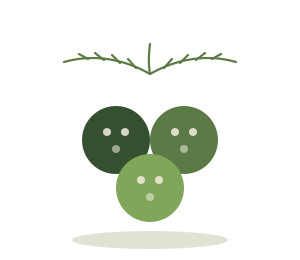
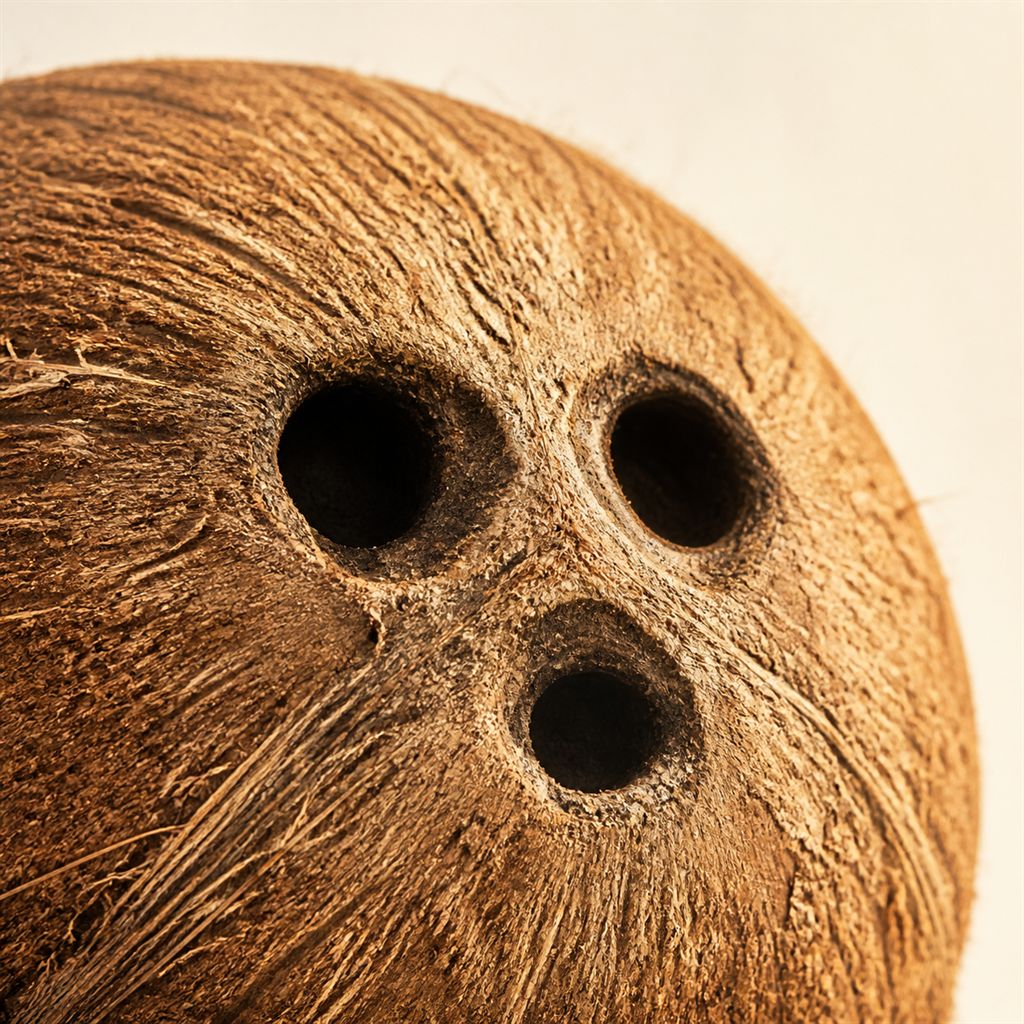
Strip the husk from any coconut and the shell shows its crown: three round germination pores set close together, two above and one below. Children see a small face there. Botany sees three doors, two of them sealed and one soft; and through that single soft pore, when a nut is allowed to be a seed rather than a drink, the sprout emerges. The soft pore is not a flaw in the shell's defence; it is the purpose of it. A palm that will stand and give for sixty years leaves the shell by one small door.
The house's marks come from this crown. The trio that recurs on its papers and its crest, the arrangement of two above one below: it is the top of the shell, drawn plainly, the way a child with a stick would draw it. The house chose the pores over a palm silhouette or a map outline because the pores say the truest available thing about the material. The shell is not packaging; it is a seed case. The husk the house washes, cures and presses spent its first life guarding water for a sprout, and every block that leaves the yard carries, in its marks, the door the sprout leaves by.
IV
The Order of Gifts
Tamil tradition calls the coconut palm கற்பக விருட்சம், kalpaka viruksham: the wish-granting tree. The name is not mystical bookkeeping; it is an audit. Nothing of the palm is wasted: leaf, timber, kernel, water, shell, husk, each to its own use and its own trade, across the sixty giving years of a single tree. And within that long account there is an order. The tender nut comes first: taken young, poured out at the roadside, gone before the engine cools. Coir and pith come last: the patient remainder of the husk, cured through six weeks of sun between husk and block, pressed, papered and sent to greenhouses that will never hear the road.
The tree's first gift is poured, not pressed.
The house works at the end of that sequence, and finds the position clarifying. The palm that fills its pallets has been giving all along the way: water at the cart, leaf and timber and kernel each to their own trades, the husk last of all. A trade that begins as a kindness keeps, if it is careful, some of the manner of one: the exactness of the cutter's strokes, the refusal to waste, the habit of handing a thing over opened rather than sealed and asserted. The house ships its blocks with the papers published for every lot, and it likes to think the cart would recognise the gesture. Here is the thing itself, opened in front of you.