The Record · Letters
The palm that carried the classics
Before the husk grew the world's seedlings, the leaf carried the Tamil canon.
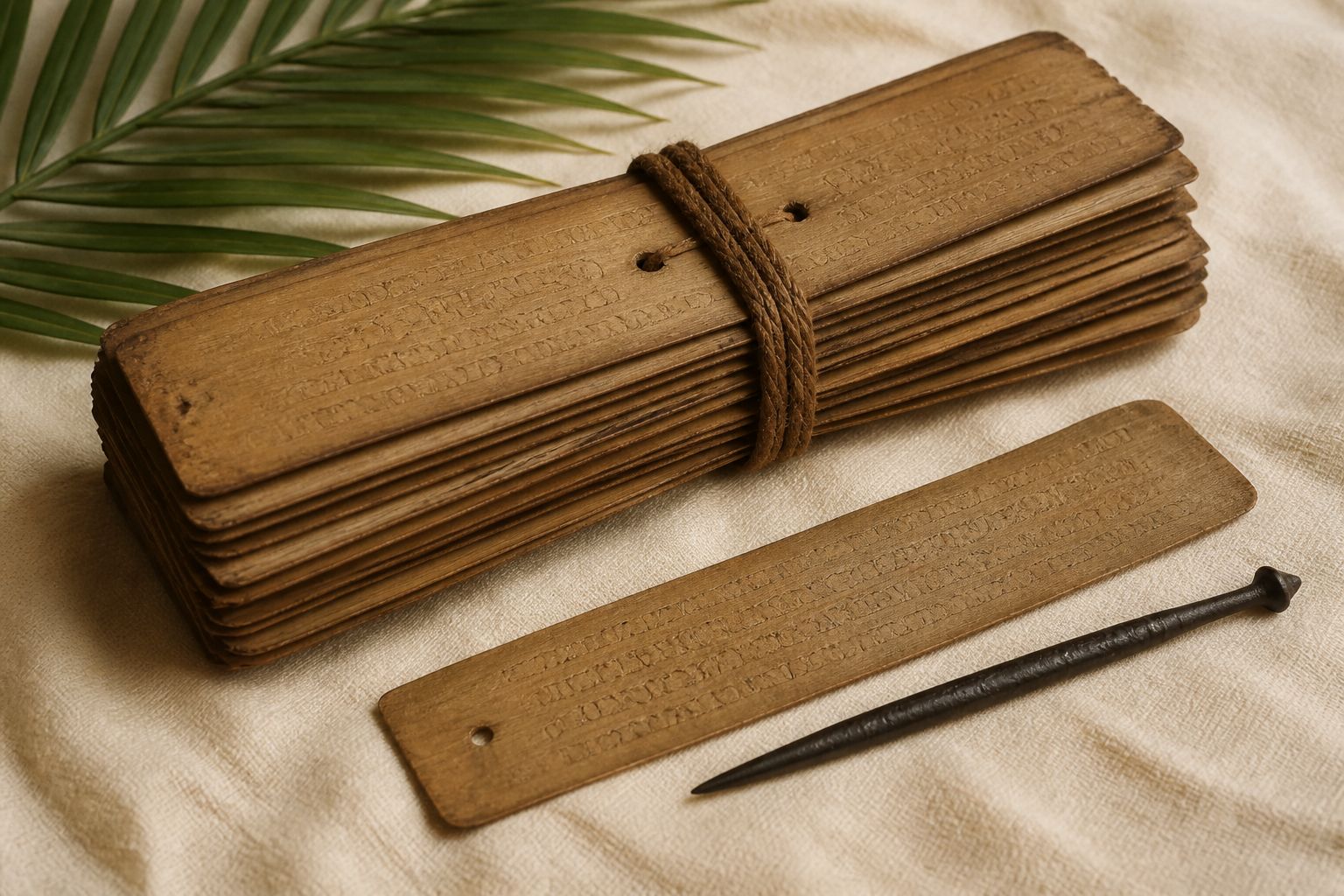
Somewhere in the south there is always a bundle of leaves that has outlived an empire: dried palm cut into long, narrow pages, strung on a cord between two boards of wood, the colour of strong tea and the weight of almost nothing. Kingdoms rose around such bundles, quarrelled, and went under; the bundles kept the poems. The Tamil classics did not come down to the present in stone or in vaults: they came down on leaf, in the palm-leaf manuscripts the language calls ஓலைச்சுவடி, olai chuvadi, copied and carried by hand through every century that might have lost them. The palm was this region's paper before it was its produce; and a house that trades in the palm's husk ought to know what its leaf once carried.
The material
The Leaf as Paper
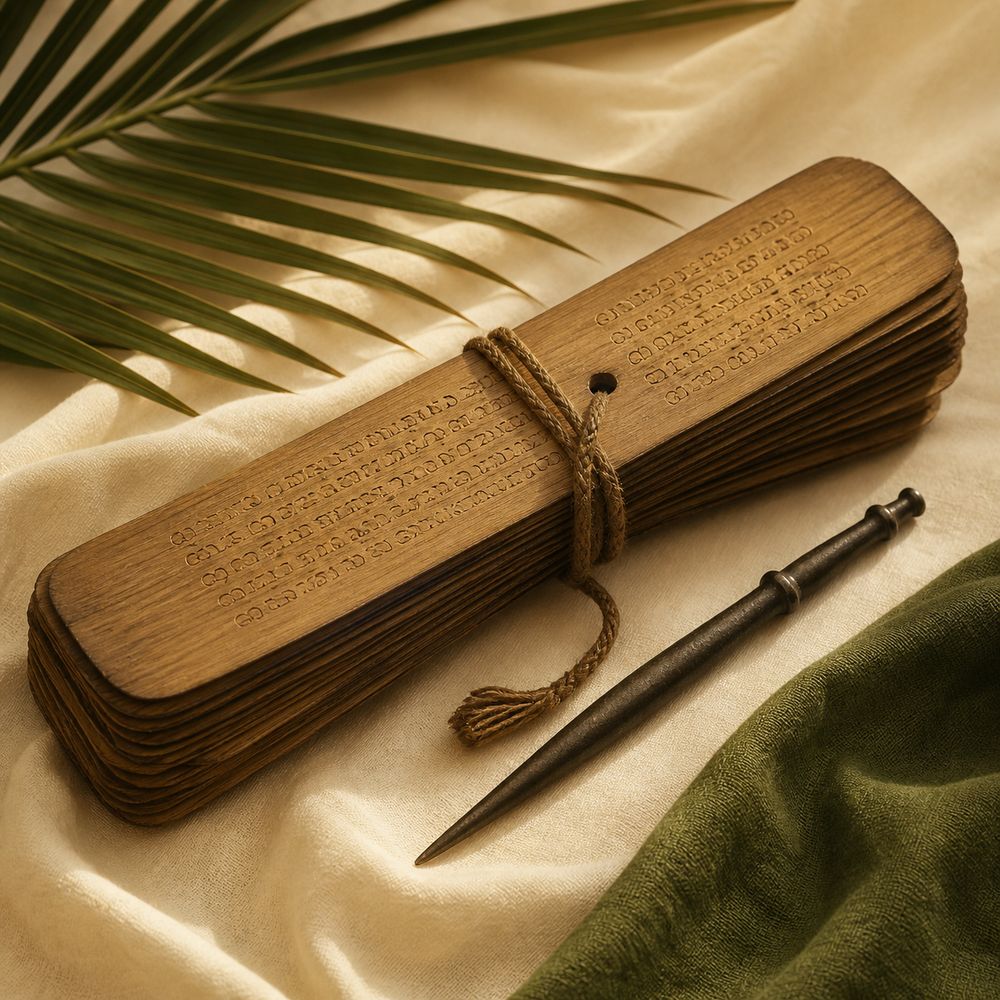
A leaf is not a page until it has been taught to be one. The leaves were cut, treated and dried with patience until they had given up their sap and their temper; then trimmed to long, even pages, smoothed, and pierced for the cord that would one day hold the book together. Only then came the writing, and the writing is the detail that still stops a reader: nothing was written on the leaf at all. The scribe took an iron stylus and incised the letters into the page, pressing the words not onto the surface but into it; the work sat closer to engraving than to ink.
A freshly written leaf was nearly blank. The text lay in it as a fine scoring, legible only when the light came in at an angle, a page holding its words the way still water holds a current. So the writer rubbed lampblack or soot across the leaf and wiped it away again; the black settled into the incisions and abandoned the surface, and the letters rose up dark and exact, as if the page had decided to speak. The finished leaves were strung on their cord between wooden boards, and the boards pressed the book flat and kept it true. A book in this country was a stack of leaves under discipline: not glued at a spine, but threaded through the heart, each page carrying the cord and carried by it.
The alphabet
The Round Hand
Look at Tamil script and the first thing the eye reports is roundness: bowls, loops, curls, closed circles. This is not ornament; it is engineering. A palm leaf has a grain, and the grain has rules. Drag a stylus straight along the fibre and the leaf refuses the line; it splits along it, and the page is lost. The straight stroke is a wound. So the hand learned to curve: to meet the grain at an angle, to turn through it, to let each letter travel around the fibre rather than against it. Write round and the leaf holds; write straight and the leaf ruins.
Centuries of that necessity settled into the shape of the alphabet itself, and the shape then outlived its reason. Tamil is written round today on paper, on painted signboards, on glass screens that would tolerate any stroke a hand could make, because the leaf would not. The material taught the alphabet its manners, and the alphabet has kept them ever since. The house holds this to be the oldest lesson in the trade and the most current one: the material sets the terms, and the craft that respects those terms is the craft whose work survives.
The letters are round because the leaf would split under a straight stroke.
The devotion
The Copyists
A leaf is patient; it is not permanent. In this climate, heat, damp and insects collected their steady rent, and a manuscript aged much as its readers did. The tradition answered mortality in the only honest way open to it: it copied. When a bundle grew brittle, a copyist sat with the old leaves on one side and fresh leaves on the other and carried the text across, letter by incised letter, until the young manuscript could take up the work of the dying one.
Every classic that reached the present did so because, in generation after generation, some hand judged it worth the labour of re-carrying; and the works no hand took up are simply gone, their titles lost with them. It is worth sitting with that. The canon is not what was written; the canon is what was recopied. Survival was never an accident of preservation: it was a decision, renewed quietly, century after century, by copyists whose own names the leaves mostly decline to record. They kept the poems by refusing to let them rest. Devotion, in this tradition, looks like repetition.
The inheritance
The Same Leaf
The house's place in this story is modest, and the house knows it. The palms of Pollachi, பொள்ளாச்சி, are grown today for the nut and worked for the husk; the fibre the world calls coir is the Tamil கயிறு, kayiru: rope. Tradition calls the palm கற்பக விருட்சம், kalpaka viruksham, the wish-granting tree, because nothing of it is wasted: trunk, leaf, flower, nut and husk, each part with its own office, and a single palm giving for sixty years. For many centuries the leaf's office was memory. The office has changed; the tree has not. The same palm that carried the classics now carries the world's seedlings: husk milled to pith, washed in mountain water, cured under the sun, pressed into blocks and sent to a British nursery, where new stock takes root in it. The leaf carried verse; the husk carries gardens; the tree has never yet carried nothing.
And when the house set out to keep a journal, it did not have to reach far for a name. The Ledger takes both its name and its duty from the manuscript tradition: write it down, keep it, hand it on. A record left untended is not a record; a promise not renewed is not a promise. The copyists kept a literature alive by carrying it forward, hand over hand, leaf over leaf, never trusting time to do the keeping for them. The house intends to keep its word in the same manner: entry by entry, season by season, written in the expectation that someone, one day, will check.