
The Record · People
The climbers of the grove
The palm is worked by hand and always has been; on the profession the industry rests on.

First light in a Pollachi grove is a grey-green hour: mist standing over the irrigation channels, the red earth still cool underfoot, the crowns of the palms just beginning to take colour far overhead. At the base of one trunk a man stands still and does not yet touch the tree. He is reading it: the lean, the state of the bark, where the night has left it damp, what this particular palm will and will not permit this morning. Then he bends, sets a short loop of woven fibre around his feet, takes the trunk in both hands, and goes up. The working day of the coir belt begins where it has always begun: at the crown of a tree, in the grip of a skill no machine has ever managed to learn.
The craft
The Ascent
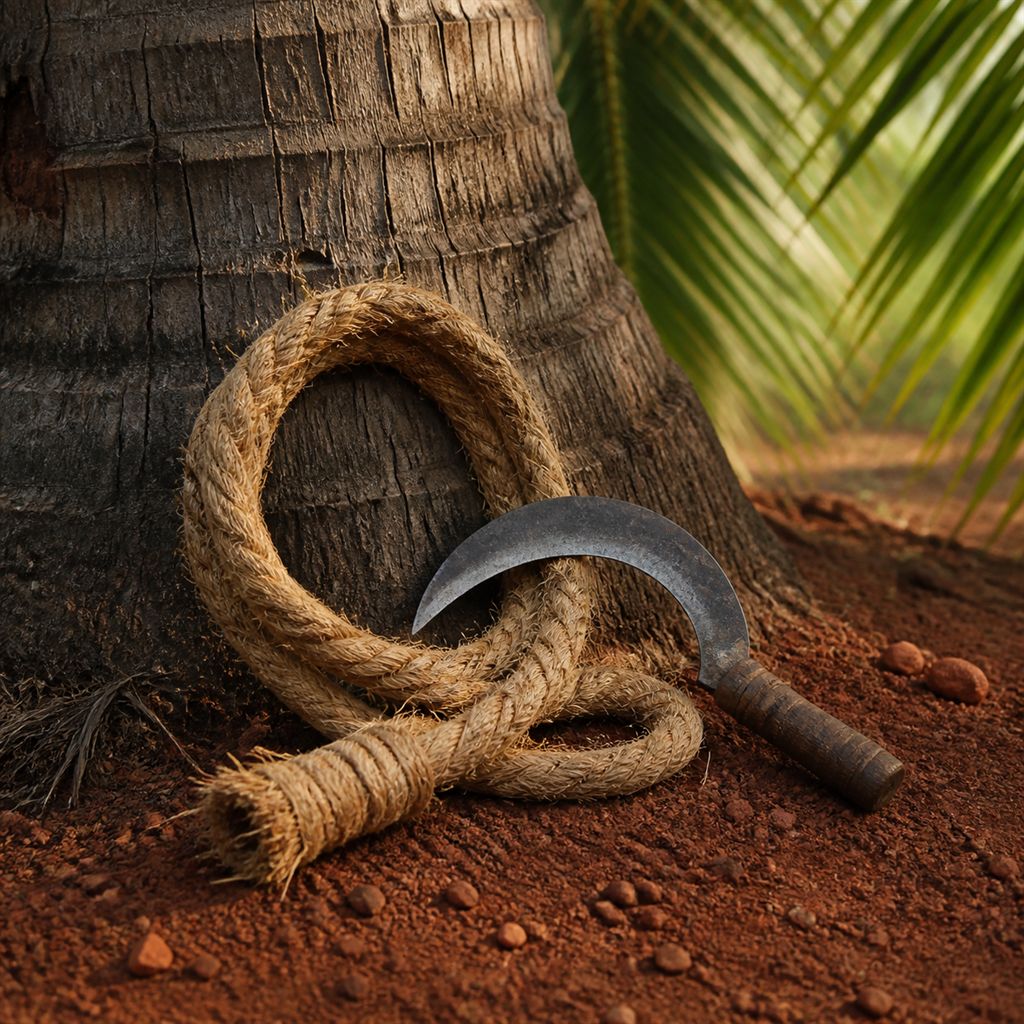
No machine harvests the tall palms of this belt. The fact deserves a plain sentence of its own, because everything else in the trade stands on it: the mills, the yards, the drying floors, the containers, the pallets in a British warehouse, all of it waits, first, on a human being going up a trunk by hand. The technique is old and exact. A loop of woven fibre, often twisted from the palm's own coir, is set around the feet, binding them into a single gripping instrument against the bark; some climbers work instead with a rope loop passed around trunk and body, leaned against and walked upward a span at a time.
Either way, the climb is a conversation with the tree. Every trunk has its own lean, and the lean makes one face of it a ladder and the opposite face a hazard; the bark has its dry stretches and its polished ones; the climber reads all of this from the ground and keeps reading it the whole way up. What strikes the watcher most is the economy. There is no haste and no flourish; not one movement is spent for show, because at that height every movement is spent from a fixed account. At the crown comes the judgement, which nuts are ready and which must wait, and then the husked weight comes down. The work is skilled and it is dangerous, and it does not pretend otherwise; gravity writes the terms of this contract, and the climber signs them again every morning.
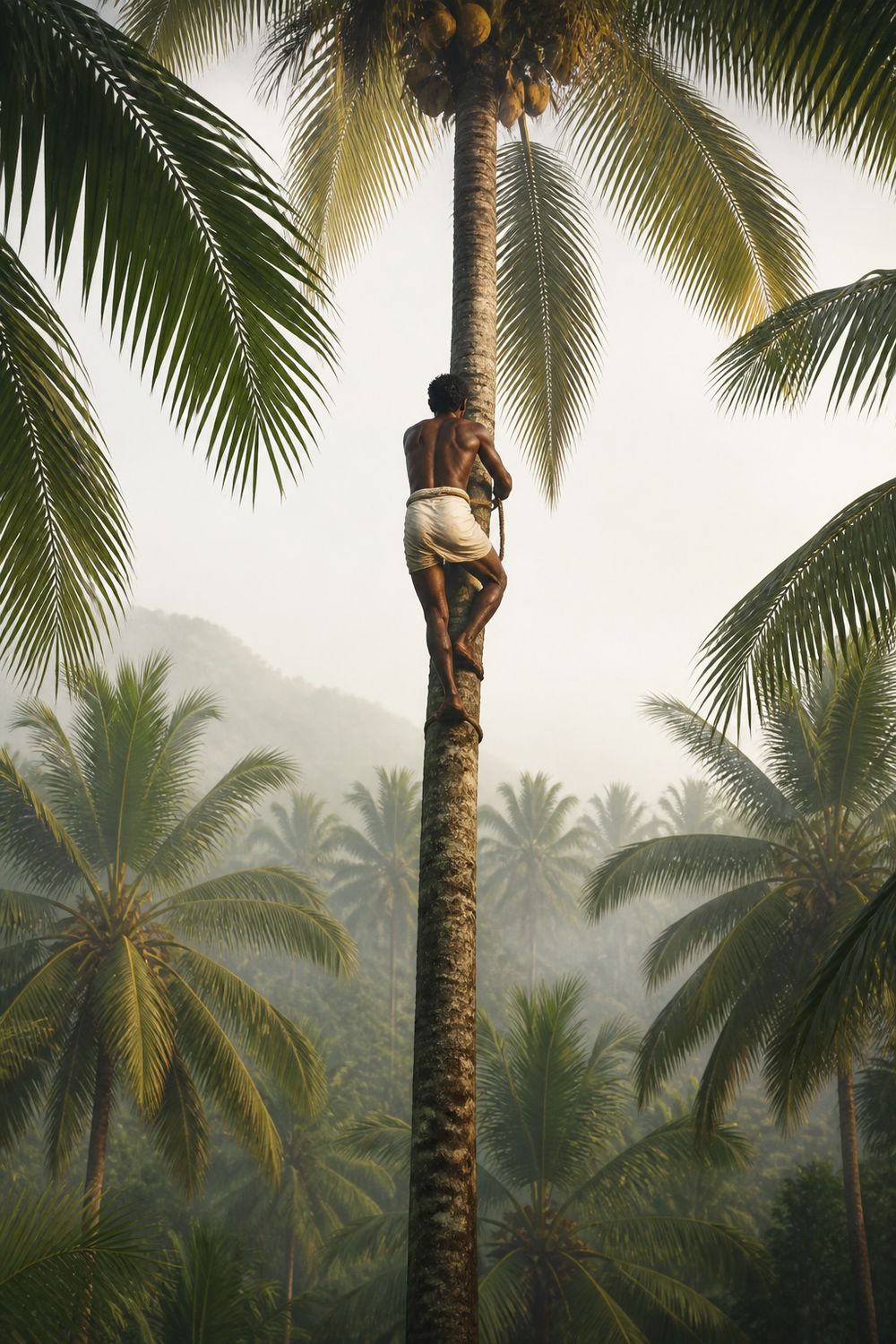
The grove has no machine for this work; it has the climber.
The family
The Inheritance
The skill is learned young, and it is learned close: from a father, an uncle, a neighbour whose trunks a child has watched since he could walk. There is no college for this work and no certificate at the end of it; there is a shorter tree, an older pair of hands, and years. That is how the belt has always carried the profession, person to person, the way this region once carried its poems: by hand, and by trust.
And the profession is ageing. Fewer young people take it up; the towns offer easier work at lesser heights, and nobody who has watched an ascent from below would blame them. What is owed to work of this kind, skilled, necessary and mostly unseen, is a debt the wider market rarely notices, because the market meets the coconut at the mill gate or the stall and never at the crown. The house notices, because it must. There is no coir without husk, no husk without harvest, and no harvest without the climber. An industry that forgets the top of its own chain is an industry describing its own end.
The commerce
The Chain
Follow one husk. It comes down from the crown before the morning heats. It travels to the mill, where the fibre is separated; the pith is washed in mountain water and spread to the sun on red earth; weeks later it is pressed into blocks, tested, numbered, wrapped and stacked; the container closes on it in Pollachi and opens on it in Britain, and the pallet stands in a nursery aisle with its record hanging from it. The chain is long, but it has exactly two ends. At one end a British grower holds a verified block; at the other, a climber holds a trunk.
The buyer holds the top of a rope; the climber holds the bottom of it. And rope is the trade's own word: the English coir is the Tamil கயிறு, kayiru: rope. The town has traded the palm's goods at its Tuesday சந்தை, sandhai, for some two centuries, and in all that time the chain has started in the same place: overhead, at first light, in a pair of practised hands. A buyer who holds the house's fibre holds the far end of that morning.
The account
The Pledge
The house films its groves and its yards for one reason: a buyer in Britain, holding a block of fibre from the other side of the world, is entitled to see the hands that made it. That is what the films are for; not theatre, but sight. And the house makes its pledge in the same spirit: its hands are named in its record. The people who stand behind a numbered pallet stand in the house's ledger by name; not on a poster, not in a caption, but in the record itself, which is where accountability lives.
Dignity is not a marketing line; it is an accounting line. It looks like prompt payment; it looks like the work entered against the name that did it; it looks like a record a climber could point to and say: that pallet, those weeks, my work. Tamil tradition calls the palm கற்பக விருட்சம், kalpaka viruksham, the wish-granting tree, because nothing of the tree is wasted. The house would add one clause to the old saying: nothing of the work should be nameless, either. A palm gives for sixty years; a climber gives a working life. The grove keeps its word to both, or the word was never worth keeping.