Field Notes · Bioengineering
Coir logs for erosion control, told plainly
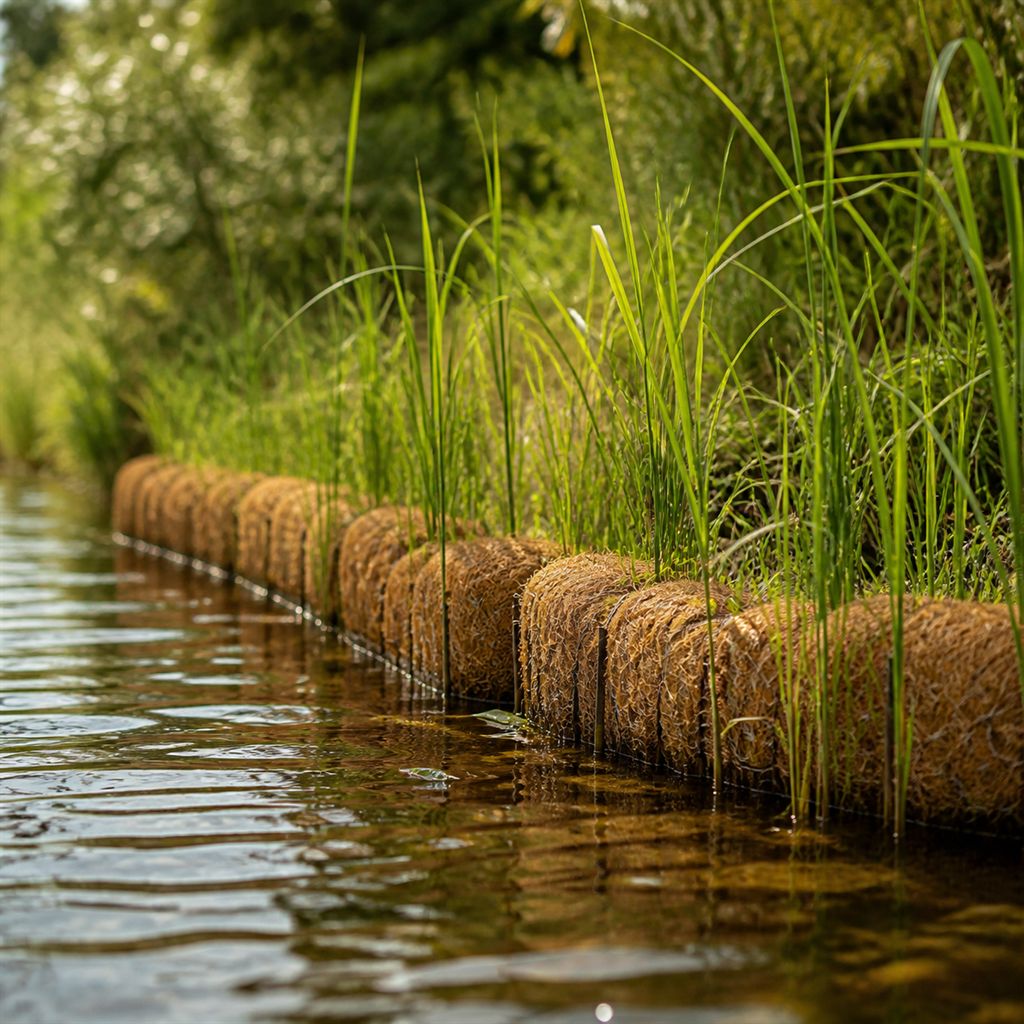
When water cuts into a riverbank or swale, rock armours it, plastic fouls it, and vegetation arrives too late on its own. Here is the third way: dense coconut fibre packed to blunt the current, hold the bank, and end as soil.
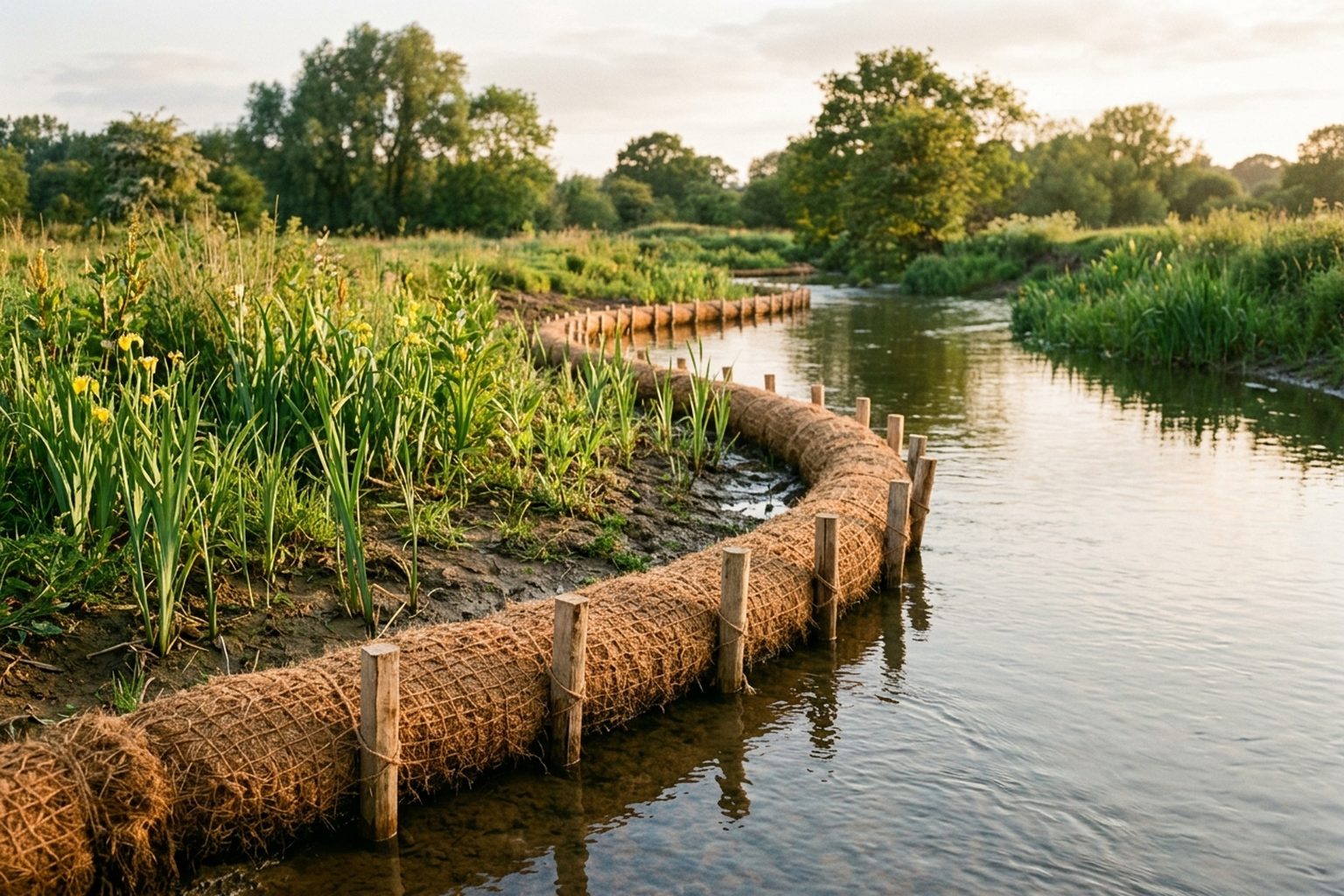
A riverbank does not fail in a single dramatic hour. It fails particle by particle, grain by grain, as water finds raw earth and pulls it away before any root can anchor. For decades, the civil engineer answered that pull with stone riprap or synthetic mesh: heavy, permanent interventions that armour the bank by burying it. Yet water margins are living systems, not concrete flumes. A bank protected by rock remains sterile; a bank wrapped in plastic netting leaves synthetic strands behind for fish, otters, and birds to tangle in. The older answer, refined in Pollachi from the husk outward, is simpler and more patient: pack the toughest natural fibre on earth into a dense roll, stake it at the waterline, and give native plants the time and shelter they need to take command.
I
The Edge Where Land Meets Water
Water moving against bare soil exerts shear stress: a quiet hydraulic drag that lifts loose silt and carries it downstream. On lake margins, wind-driven wave lap gouges the toe of the slope; on river bends, high flows carve out undercuts until the overhang collapses of its own weight. The vulnerable season is always the beginning: the newly regraded channel, the excavated retention basin, or the restored stream bank before reed seeds have germinated.
Left unprotected, a fresh bank will wash out during the first seasonal flood. Planted directly into bare mud, young sedges and flags are swept away before their root hairs can grip. The bank needs structure at once, but it does not need that structure forever. It requires an interim guardian: something tough enough to absorb the river's energy for several seasons, moist enough to nurse plant roots, and humble enough to disappear once its task is finished.
II
How the Log Is Built
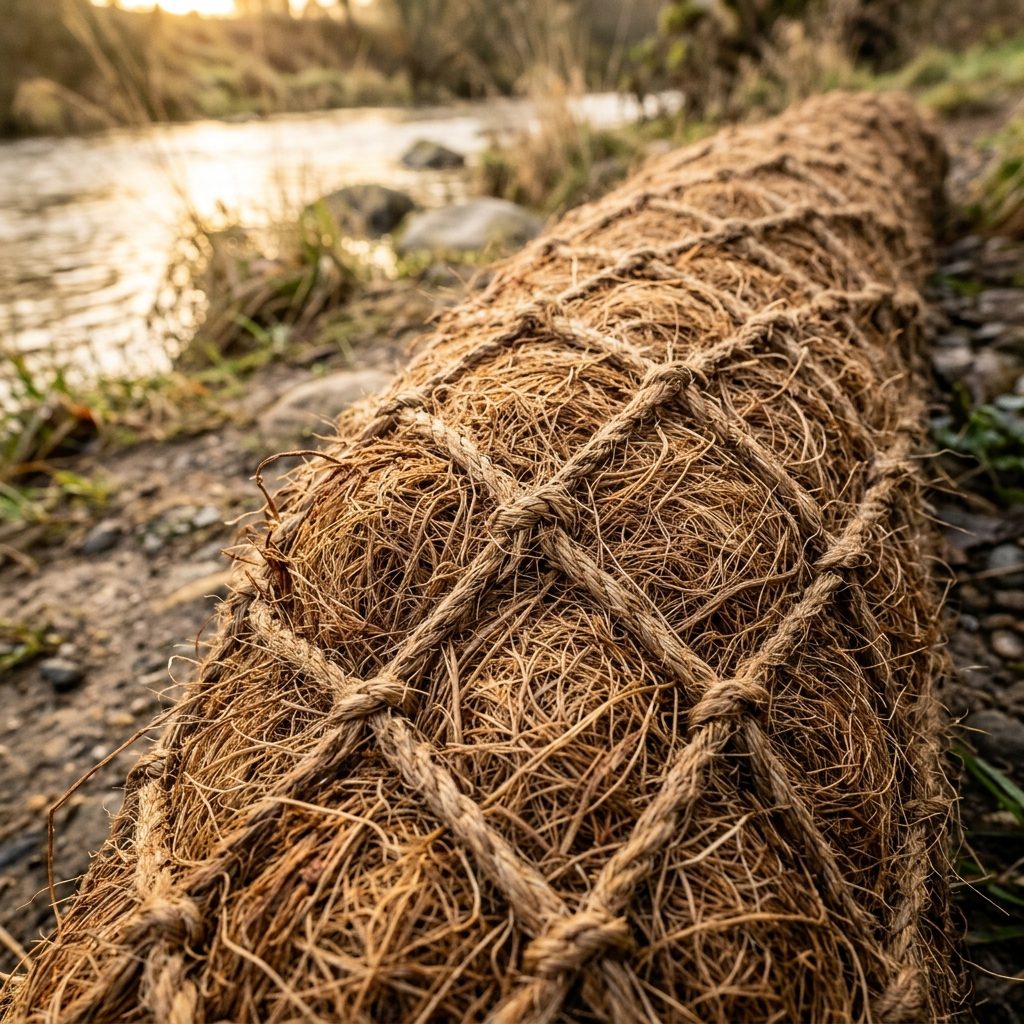
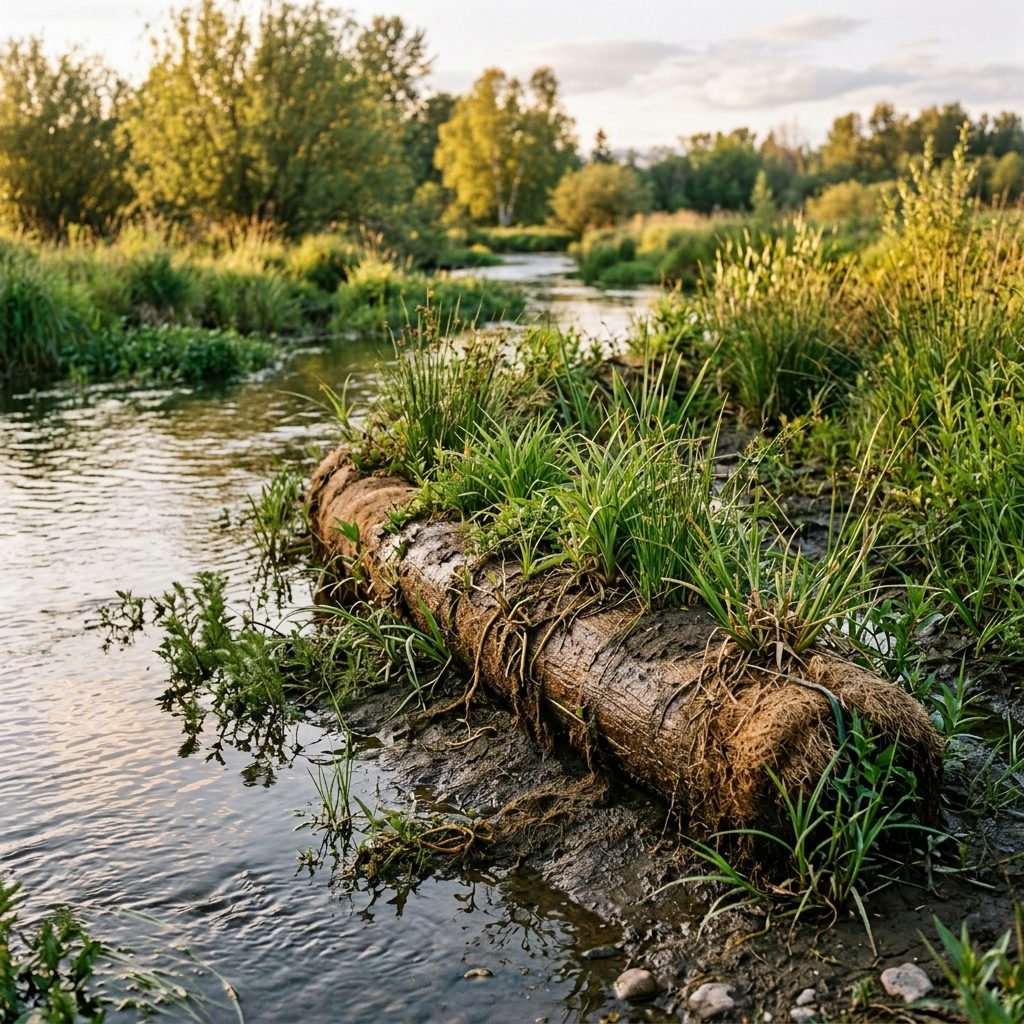
A coir log, often called a coir roll or cocopeat wattle, is straightforward in design and exacting in execution. It consists of two components, both derived entirely from the coconut husk. The core is clean, mattress-grade coir fibre, packed at high mechanical pressure into a continuous cylindrical roll. The outer casing is a tough, tubular sleeve of open-mesh netting hand-knotted from twisted coir yarn. The Tamil word for coir is கயிறு, kayiru: rope. That knotting is deliberate: the open square mesh gives the log structural integrity while leaving open spaces for plant plugs to be pushed directly into the core.
Pollachi Coir produces these logs in standard 3 metre lengths, with diameters ranging from 15 centimetres up to 50 centimetres. A 30 centimetre log can weigh between 25 and 35 kilograms when packed to the density required for active waterways. Crucially, nothing synthetic is added. There are no polypropylene filaments, no nylon threads, and no plastic zip-ties. When a bioengineering project specifies natural coir, it expects the entire installation to return to the earth without leaving microplastics in the watercourse.
III
Breaking Velocity, Trapping Silt
When current strikes a solid concrete wall or heavy stone riprap, water cannot penetrate. The kinetic energy deflects, swirling into violent eddies that scour the river bottom immediately below the structure or chew into the unarmoured bank downstream. Coir logs work on a different hydraulic principle: they are porous.
When high water hits a dense coir log, some flow glances off the round profile, but water also filters through the packed fibre mass. The millions of stiff, bristly fibres create friction, bleeding off velocity without generating severe turbulence. As the current slows within and behind the roll, the water drops its suspended sediment. Silt settles into the fibre matrix, packing the interstices with fertile river mud. Instead of eroding the bank, the river begins rebuilding it.
A coir log does not fight the river: it slows the water down and turns its cargo into bank.
IV
Direct Planting and the Root Bridge
The true genius of the coir log is that it acts as a nursery. Unlike stone, coir has a high moisture retention capacity. While the outer fibres face the wash of the current, the interior stays continuously damp, drawing water up from the stream bed by capillary action.
Contractors do not wait for seeds to drift in on the breeze. They cut small pockets into the top of the roll or push bare-root wetland plants directly between the yarn meshes into the packed centre. Yellow flag iris, sedges, rushes, and water mint find an ideal rooting medium. Their roots spread through the moist fibre, weaving through the log and anchoring deep into the subsoil bank behind. By the second summer, the log is no longer just a cylinder of fibre: it is an interwoven living mattress of root mass that grips the subgrade far more tenaciously than any unplanted ground ever could.
V
Seasons, Then Soil
A question often put to the house is longevity: how long does a coir log last? In typical aquatic conditions across Britain and Northern Europe, a dense coir log maintains its structural strength for two to five seasons. That lifespan is not an accident of nature; it is the exact window required for ecological succession.
During the first year, when the bank is raw, the coir log bears the full hydraulic load. By the second year, the roots of the established reeds have formed an interlocking web that shares the strain. As the high-lignin coconut fibres slowly break down under microbial action, they degrade into rich, organic humus. By the time the netting loosens and the cylinder yields, the living root system has matured into a permanent, self-healing natural bank. There is nothing to dig up, nothing to haul away, and no synthetic plastic netting left behind to entrap water voles or fish.
VI
Why Pollachi Fibre Holds
Not all coir fibre performs equally under water. The coir exported from the Pollachi cluster owes its resilience to the climate of the Anaimalai foothills: year-round sunshine, steady monsoon moisture, and mature coconut palms that produce thick, well-lignified husks. High lignin content gives Pollachi coir fibre its characteristic golden-bronze colour and its remarkable resistance to premature fungal rot when submerged.
In our yards, the fibre is carefully cured, combed, and packed to precise densities. When an engineer orders a 30 centimetre diameter roll, it arrives uniformly firm along its entire 3 metre length, free from hollow spots or loose packing that could collapse under a winter surge. Every consignment leaves the yard with its lot papers and specifications verified, matching the standard set out in our catalogue.